Original post 7/28/2006
I see that Ralph Luker has picked up on this Boston Globe piece about the last four surviving Shakers in America. I read the piece, but I suppose I didn't blog about it because, since I go past the small compound many times a year on my way to my in-laws house in Poland, Maine, I kind of forgot how unique the Shakers really are (familiarity breeds....ennui?). That is something I learned when I visited the Shaker Village in the early 1980s (a982, I think) as part of the innovative program called The Maine Journey (started by the late Suzanne Smith) and I shouldn't have let my regular drive-bys obscure this fact. (Bad Historian! Bad!)
On the face of it, a 12 or 13 year old boy can think of more exciting things to see than a religious retreat that consists of a few elderly ladies and a slightly odd man in his thirties (which is what the group was made up of in the early 1980's). In fact, what may seem so different to us in today's hi-tech world--the farming, gardening, raising animals, in short, the simple life--wasn't all that strange to anyone growing up in rural Maine. But being introduced to the Shakers' radical definition of equality was an eye-opener to a small town kid. Not only did they believe in "separate-but-equal" (men and women have different doors to the church--or meeting house, first instance), but their vow of celibacy meant they could only continue as a community by replenishing their ranks from outside. And while they had used adoption in the past, that practice had stopped in the 1960's and people weren't exactly banging down the doors to live a 19th century-style life of celibacy back in the 1970s and 80s.
Even a distracted kid of 13 could see that they were probably fighting a losing battle to stay viable. And while it seemed strange that these people took their notion of equality to the degree which they did, I admired them for not compromising their principles. I also definitely picked up on the inherent peacefulness of the whole village. It was a nice, relaxing place to visit--even with 50 or so 13 year old boys and girls running around (actually, we were a generally well-behaved bunch--at least by 13 year old standards--and we didn't even need Ritalin!).
One final note: the Shaker gift shop also sold some interesting items. I and many other kids purchased spruce gum and a mouth harp (also called a Jew's Harp). The gum was certainly an "acquired" taste, and though The Maine Journey impromptu mouth-harp band probably didn't sound very good to the outsider, it provided a couple hours worth of entertainment as we made our way back home. Especially whenever one of us "twanged" the flexible metal vibrator part into our teeth--then the "wango wang" of the harp would be puctuated by a "Yelp!" followed by the laughter of boys and girls revelling in the pain of their pals.
Sunday, January 10, 2010


Pearl Harbor and 9/11: The Conspiracy Theorist's "If...Then..." Statement
Original post 12/7/06
With this marking the 65th anniversary of the "day that will live in infamy", inumerable editorials and essays will be written comparing WWII to the War in Iraq and the wider fight against terrorism. Invevitably, the conspiracy theories surrounding FDR's foreknowledge of an attack on Pearl Harbor, "the backdoor to war" theory, will be dredged up again and contemporized with comparisons to similar theories about a government conspiracy being behind 9/11. You see, if it could happen then, it could happen now, right? The problem, of course, is that it didn't happen then.
In 1981, Gordon Prange's At Dawn We Slept was published posthumously. Prange had served in post-War Japan and eventually gone on to being a history professor at the University of Maryland. He spent a lifetime accumulating both Japanese and American documents and conducting interviews in a quest to determine whether or not there was a conspiracy.
Prange clearly lays the Pearl Harbor attack at the feet of the attackers and, more broadly, he clearly blames Japanese foreign policy and militarism for aggression in China, expansion in Southeast Asia and for making the decision to go to war with the U.S.
According to Prange, many within the Japanese navy and military opposed an attack on Pearl Harbor. The actual plan was devised by Minoru Genda, a Japanese Air officer, and it was only approved at the 11th hour when Admiral Isoroku Yamamoto threatened to resign. (One of the bigger ironies is that Yamamoto had tried to convince his superiors that going to war with the U.S.--with it's population, economic and industrial might--was not a good idea). One of those who had disagreed was Admiral Chuichi Nagumo but the rules of seniority dictated that he lead the attack and he followed his orders. Howerver, Nagumo had very little experience with naval aviation and Yamamoto assigned Genda to Nagumo's command. In short, neither the Japanese plan nor the men implementing it were infallible.
In fact, the Japanese unwittingly gave the U.S. some clues of an imminent attack and Prange provides some examples of such early warnings that could and should have tipped off U.S. forces that something was up. One example was that the first casualty of the attack was a Japanese submarine that was sunk by a U.S. destroyer one hour before the attack. This might have been reported to the U.S. Army in Oahu, which might have put the island on alert. But it didn't happen. Such clues could have been gathered and analyzed with greater imagination and less red tape in Honolulu and Washington, D.C.
At this point, it's worth taking leave of Prange for a bit and treating with Roberta Wohlstetter, whose Pearl Harbor: Warning and Decision still provides one of the best studies of the uses and functions of military and political intelligence in crisis.*
Wohlstetter outlined the U.S. "magic" intelligence operation that enabled the U.S. to read Japanese diplomatic codes (not military), and thus any attempt to claim that U.S. codebreakers had information regarding an attack was missplaced. In addition to "magic", radio signals were picked up that may have led someone to conclude that an attack was imminent, but Wholstetter notes that such signals only appear to be the most important in hindsight and that, within the course of day to day activity, they may have been missed or lost in the general "noise" of the time.
As Wohlstetter emphasized, any technical advantages were often outweighed and hamstrung by the organizational defects and shortage of personnel within the U.S. Government. Even when accurate and valuable intelligence was gathered, there were still two hurdles to jump. First, the decision makers at the top had to be persuaded that the intelligence was important. Second, even if this was accomplished, there were institutional and bureaucratic roadblocks that frustrated attempts to turn information into actionable orders. As Walter Millis wrote in his review of Wohlstetter's book (American Historical Review, volume 68, #2):
Admiral Husband Kimmel and General Walter Short commanded the Navy and Army at Pearl Harbor, respectively. After the attack at Pearl Harbor, both would be charged by the Roberts Commission with "dereliction of duty" and cast as the scapegoats. (Eventually, though, history would rectify the situation). Prange concluded that this was undeserved and determined that blame for being unprepared for the Pearl Harbor attack went from FDR on down.
That's not to say that Prange didn't find shortcomings with each commander, however. Kimmel didn't conduct long-range air reconnaisance during the week prior to the attack and Short misunderstood his mission: he was prepared for sabotage and safeguarded against this threat by clustering his planes together because it was easier to protect them if they were grouped together. Unfortunately, this made them all the more easy to hit from the air. He hadn't taken an air assault into account.
As for Washington, Prange explained that the Navy and War departments didn't do a good job of keeping Kimmel and Short up to speed and they didn't follow up on various warnings. The War department mistakenly thought that Short was on alert for both sabotage and other forms of assault and a number of key men in the Navy department actually thought that Kimmel's entire fleet (not just a few aircraft carriers) was at sea. Finally, Prange laid some blame at the feet of FDR, who he believed treated Japan to lightly and whose desire to not alarm the American public of the growing crisis with Japan left the public unprepared for war.
Prange summarized his conclusions thus:
ADDENDUM: For a historiographical survey of the "back door to war" debate amongst historians, Martin V. Melosi's "The Triumph of Revisionism: The Pearl Harbor Controversy, 1941-1982" {The Public Historian, Vol.5, No.2 (Spring 1983)} is very useful. Melosi himself is a Pearl Harbor revisionist (The Shadow of Pearl Harbor: Political Controversy over the Surprise Attack, 1941-1976), and while he "accept[s] the revisionist claim that the Roosevelt administration initiated a cover-up of Pearl Harbor" he also ultimately disagreed with the notion that "FDR and his chief advisors had encouraged the attack and therefore were trying to conceal their guilt." Instead, Melosi believes "that they wished to protect Roosevelt's foreign policy by quashing a political controversy over the question of responsibility." ("Triumph of Revisionism, 90.").
Frankly, I haven't the stomach to venture into the world of 9/11 conspiracy debunking, though Popular Mechanics (and many others) have.
* Its' worth mentioning that a Google search of Wohlstetter's book leads to a copy of a 1966 critique of same by Charles C. Hiles, who accuses Wholstetter of using the "blurout" method to distract the reader from the "real facts" of the attack. A close reading of Hiles piece indicates that he agrees that there was too much "noise" in Washington, but he asserts that Wholstetter's focus on contingency is misplaced and that an unseen "monkey wrench" had been thrown into the gears of government. That there was an invisible wall put up between the political branch and the military and that:
With this marking the 65th anniversary of the "day that will live in infamy", inumerable editorials and essays will be written comparing WWII to the War in Iraq and the wider fight against terrorism. Invevitably, the conspiracy theories surrounding FDR's foreknowledge of an attack on Pearl Harbor, "the backdoor to war" theory, will be dredged up again and contemporized with comparisons to similar theories about a government conspiracy being behind 9/11. You see, if it could happen then, it could happen now, right? The problem, of course, is that it didn't happen then.
In 1981, Gordon Prange's At Dawn We Slept was published posthumously. Prange had served in post-War Japan and eventually gone on to being a history professor at the University of Maryland. He spent a lifetime accumulating both Japanese and American documents and conducting interviews in a quest to determine whether or not there was a conspiracy.
Prange clearly lays the Pearl Harbor attack at the feet of the attackers and, more broadly, he clearly blames Japanese foreign policy and militarism for aggression in China, expansion in Southeast Asia and for making the decision to go to war with the U.S.
According to Prange, many within the Japanese navy and military opposed an attack on Pearl Harbor. The actual plan was devised by Minoru Genda, a Japanese Air officer, and it was only approved at the 11th hour when Admiral Isoroku Yamamoto threatened to resign. (One of the bigger ironies is that Yamamoto had tried to convince his superiors that going to war with the U.S.--with it's population, economic and industrial might--was not a good idea). One of those who had disagreed was Admiral Chuichi Nagumo but the rules of seniority dictated that he lead the attack and he followed his orders. Howerver, Nagumo had very little experience with naval aviation and Yamamoto assigned Genda to Nagumo's command. In short, neither the Japanese plan nor the men implementing it were infallible.
In fact, the Japanese unwittingly gave the U.S. some clues of an imminent attack and Prange provides some examples of such early warnings that could and should have tipped off U.S. forces that something was up. One example was that the first casualty of the attack was a Japanese submarine that was sunk by a U.S. destroyer one hour before the attack. This might have been reported to the U.S. Army in Oahu, which might have put the island on alert. But it didn't happen. Such clues could have been gathered and analyzed with greater imagination and less red tape in Honolulu and Washington, D.C.
At this point, it's worth taking leave of Prange for a bit and treating with Roberta Wohlstetter, whose Pearl Harbor: Warning and Decision still provides one of the best studies of the uses and functions of military and political intelligence in crisis.*
Wohlstetter outlined the U.S. "magic" intelligence operation that enabled the U.S. to read Japanese diplomatic codes (not military), and thus any attempt to claim that U.S. codebreakers had information regarding an attack was missplaced. In addition to "magic", radio signals were picked up that may have led someone to conclude that an attack was imminent, but Wholstetter notes that such signals only appear to be the most important in hindsight and that, within the course of day to day activity, they may have been missed or lost in the general "noise" of the time.
As Wohlstetter emphasized, any technical advantages were often outweighed and hamstrung by the organizational defects and shortage of personnel within the U.S. Government. Even when accurate and valuable intelligence was gathered, there were still two hurdles to jump. First, the decision makers at the top had to be persuaded that the intelligence was important. Second, even if this was accomplished, there were institutional and bureaucratic roadblocks that frustrated attempts to turn information into actionable orders. As Walter Millis wrote in his review of Wohlstetter's book (American Historical Review, volume 68, #2):
The best intelligence in the world will never give unambiguous signs; it must leave it to statesmanship to make those hard decisions to which no certainty as to outcome or effect can ever attach.Prange concluded that most U.S. officials in positions of authority knew that an attack like that which would occur at Pearl Harbor was possible, but most believed the Japanese would never take such a risk. Washington was focused on threats in SE Asia, not Hawaii, and they mistakenly believed that the commanders in Oahu had been properly warned and were prepared for a potential attack.
Admiral Husband Kimmel and General Walter Short commanded the Navy and Army at Pearl Harbor, respectively. After the attack at Pearl Harbor, both would be charged by the Roberts Commission with "dereliction of duty" and cast as the scapegoats. (Eventually, though, history would rectify the situation). Prange concluded that this was undeserved and determined that blame for being unprepared for the Pearl Harbor attack went from FDR on down.
That's not to say that Prange didn't find shortcomings with each commander, however. Kimmel didn't conduct long-range air reconnaisance during the week prior to the attack and Short misunderstood his mission: he was prepared for sabotage and safeguarded against this threat by clustering his planes together because it was easier to protect them if they were grouped together. Unfortunately, this made them all the more easy to hit from the air. He hadn't taken an air assault into account.
As for Washington, Prange explained that the Navy and War departments didn't do a good job of keeping Kimmel and Short up to speed and they didn't follow up on various warnings. The War department mistakenly thought that Short was on alert for both sabotage and other forms of assault and a number of key men in the Navy department actually thought that Kimmel's entire fleet (not just a few aircraft carriers) was at sea. Finally, Prange laid some blame at the feet of FDR, who he believed treated Japan to lightly and whose desire to not alarm the American public of the growing crisis with Japan left the public unprepared for war.
Prange summarized his conclusions thus:
Pearl Harbor resulted from a vast combination of interrelated, complicated, and strange historical factors: on the one hand, bountiful human errors of great variety, false assumptions, fallacious views, a vast store of intelligence badly handled; on the other, precise planning, tireless training, fanactical dedication, iron determination, technical know-how, tactical excellence, clever deception measures, intelligence well gathered and effectively disseminated, plain guts--and uncommon luck. (pp. xv-xvi)Couldn't the same be said of 9/11?
We learned that the institutions charged with protecting our borders, civil aviation, and national security did not understand how grave this threat [terrorism] could be, and did not adjust their policies, plans, and practices to deter or defeat it. We learned of fault lines within our government--between foreign and domestic intelligence, and between and within agencies. We learned of the pervasive problems of managing and sharing information across a large and unwieldy government that had been built in a different era to confront different dangers.To expect a large, sloth-like federal government to be flexible enough to take preventative actions in the face of unforseen threats is not realistic. Both Japan and terrorism were viewed as distant threats by the U.S. government. Of course, in each instance, there were those within the national defense and political structure who were alarmed and attempted to warn their superiors that oceans didn't protect the U.S. 9/11 wasn't the first time that those who had suspicions of a pending attack couldn't get themselves heard, through no fault of their own. The experience of Pearl Harbor shows that, tragically, the inability of government to act preemptively is neither new nor surprising.
{From the Preface of The 9/11 Commission Report}
ADDENDUM: For a historiographical survey of the "back door to war" debate amongst historians, Martin V. Melosi's "The Triumph of Revisionism: The Pearl Harbor Controversy, 1941-1982" {The Public Historian, Vol.5, No.2 (Spring 1983)} is very useful. Melosi himself is a Pearl Harbor revisionist (The Shadow of Pearl Harbor: Political Controversy over the Surprise Attack, 1941-1976), and while he "accept[s] the revisionist claim that the Roosevelt administration initiated a cover-up of Pearl Harbor" he also ultimately disagreed with the notion that "FDR and his chief advisors had encouraged the attack and therefore were trying to conceal their guilt." Instead, Melosi believes "that they wished to protect Roosevelt's foreign policy by quashing a political controversy over the question of responsibility." ("Triumph of Revisionism, 90.").
Frankly, I haven't the stomach to venture into the world of 9/11 conspiracy debunking, though Popular Mechanics (and many others) have.
* Its' worth mentioning that a Google search of Wohlstetter's book leads to a copy of a 1966 critique of same by Charles C. Hiles, who accuses Wholstetter of using the "blurout" method to distract the reader from the "real facts" of the attack. A close reading of Hiles piece indicates that he agrees that there was too much "noise" in Washington, but he asserts that Wholstetter's focus on contingency is misplaced and that an unseen "monkey wrench" had been thrown into the gears of government. That there was an invisible wall put up between the political branch and the military and that:
The unseen "monkey wrench" was having its effect; the gears were grinding, producing plenty of "noise" but of a far different kind than that heard by Dr. Wohlstetter.Thus, the "monkey wrench" was a widespread government conspiracy, plain to see by all, but too complicated for him to have explained. According to Hiles we were headed to war anyway because FDR had been provoking the Japanese for just such an outcome. Pearl Harbor was just cover. See Melosi, above.
There is no need to elaborate here on the mechanics of this figurative operational "monkey wrench." It was a hydra-headed thing of which considerations of space prohibit any detailed exposition in a brief discussion such as this.
Tuesday, September 22, 2009
Review: The Masonic Myth
Jay Kinney, The Masonic Myth: Unlocking the Truth About the Symbols, the Secret Rites, and the History of Freemasonry.
Even before I was a trained (if not practicing) historian, I was a conspiracy theory skeptic. Particularly about those concerning secret societies ruling the world. Since when do men vain enough to want to rule the world also want to keep it quiet? To me, that seems to require a unique bit of schizophrenic passive narcissism. And, if we are to believe the conspiracy theorists, this has gone on for generations.
Kinney's book, The Masonic Myth, helps to solidify my skepticism concerning one group that again finds itself thrust into the spotlight with the release of Dan Brown's latest book. Brown is but the latest to "expose" the supposed world-ruling intentions of the Masons (witness the Hysterical Channel's recent "special"). Kinney takes the novel approach of explaining, with sources, the mysteries of Masonry and the problems it faces. Of course, true conspiracy theorists would probably find the fact that Kinney is himself a Mason disqualifying. That would be too bad.
What Kinney does is show that Masonry gathered certain cultural symbols and motifs that were common to other organizations. Further, they shrouded their organization in secrecy and confused their own origins, both of which played into theories of conspiracy. Further, Kinney shows that what most current Masons care most about is the senior citizen's special and their AARP membership. Like most other men's organizations--the Lions, Elks, Oddfellows--the Masons are literally dying off. Will the New World order survive?
Whether it does or not, Kinney has done a great service to those interested in a well-researched and factual account of the origin and current state of Freemasonry.
Even before I was a trained (if not practicing) historian, I was a conspiracy theory skeptic. Particularly about those concerning secret societies ruling the world. Since when do men vain enough to want to rule the world also want to keep it quiet? To me, that seems to require a unique bit of schizophrenic passive narcissism. And, if we are to believe the conspiracy theorists, this has gone on for generations.
Kinney's book, The Masonic Myth, helps to solidify my skepticism concerning one group that again finds itself thrust into the spotlight with the release of Dan Brown's latest book. Brown is but the latest to "expose" the supposed world-ruling intentions of the Masons (witness the Hysterical Channel's recent "special"). Kinney takes the novel approach of explaining, with sources, the mysteries of Masonry and the problems it faces. Of course, true conspiracy theorists would probably find the fact that Kinney is himself a Mason disqualifying. That would be too bad.
What Kinney does is show that Masonry gathered certain cultural symbols and motifs that were common to other organizations. Further, they shrouded their organization in secrecy and confused their own origins, both of which played into theories of conspiracy. Further, Kinney shows that what most current Masons care most about is the senior citizen's special and their AARP membership. Like most other men's organizations--the Lions, Elks, Oddfellows--the Masons are literally dying off. Will the New World order survive?
Whether it does or not, Kinney has done a great service to those interested in a well-researched and factual account of the origin and current state of Freemasonry.
Friday, September 18, 2009
What is Historiography Again?
Yikes, been a while! Anyway, I've written plenty about historiography and historical theory/methodology, but Heather Cox Richardson offers a good way to help people understand just what the heck "historiography" is:
It may be easier to understand the concept of historiography if you put the idea of it into a different context. Think of movie Westerns. Almost invariably, they deal with the Plains West from about 1860 to about 1900. But their interpretations of the events of those years are strikingly different. It’s impossible, for example, to image someone making Brokeback Mountain in 1950, or Stagecoach in the 1980s. Just as those movies tell us a great deal about both the eras in which they were made and the filmmaking theories under which they were filmed, so too can historiography tell us much that we need to know about society.That works for me.
Thursday, August 06, 2009
Berkowitz reviews Allitt's The Conservatives: Ideas and Personalities Throughout American History
Peter Berkowitz reviews Patrick Allitt's The Conservatives: Ideas and Personalities Throughout American History in the latest Policy Review. Berkowitz explains that Allitt helps explain the "paradoxes that constitute conservatism in America."
The questions that guide his study are straightforward: “Where did conservatism come from, what are its intellectual sources, and why is it internally divided?” In answering them, however, he is obliged to undertake considerable intellectual legwork because a recognized conservative movement in America only came into existence after 1950. This doesn’t prevent Allitt from reconstructing “a strong, complex, and continuing American conservative tradition” stretching from The Federalist to the Federalist Society. It does mean, though, that to justify his decisions about whom and what to include and exclude in the absence of a formal conservative tradition, a common canon, and an established set of spokesmen, Allitt is compelled to spell out the conflicting elements that distinguish a distinctively conservative approach to politics in America.I particularly liked Allitt's definition of American Conservatism (as summarized by Berkowitz):
Allitt does not seek to go beyond his role as a historian. Yet his learned and fair-minded reconstruction lends support to the view that the proper way forward for conservatives is neither greater purity nor a more perfect unity, but a richer appreciation of the paradoxes of modern conservatism and a more assiduous cultivation of the moderation that is necessary to hold conservatism’s diverse elements, frequently both complementary and conflicting, in proper balance.
According to Allitt, conservatism is, first, “an attitude to social and political change that looks for support to the ideas, beliefs, and habits of the past and puts more faith in the lessons of history than in the abstractions of political philosophy.” Second, it involves “a suspicion of democracy and equality.” This can be divided into a concern that the formal equality of men before God and law not be confused with equality in all things, particularly virtue, and that too much government power not be placed directly in the people’s hands. Third, conservatism reflects “the view that civilization is fragile and easily disrupted” and therefore it teaches that “the survival of the republic presupposes the virtue of citizens” and calls for “a highly educated elite as guardians of civilization.”
Saturday, August 01, 2009
Burgundians and Tolkien's Sigurd and Gudrun
N.B. Cross-posted at Burgundians in the Mist.
J.R.R. Tolkien's The Legend of Sigurd and Gudrun--his reworking of the Germanic/Norse legends of Sigurd and the subject matter of the Niebelungenlied, the Eddas and others--was published earlier this year to mostly positive reviews (but not all). As with all of his father's posthumous works, Tolkien's son Christopher culled and edited notes rough drafts (including lecture notes given by Prof. Tolkien who was an accomplished academic linguist) for presentation in a book. The younger Tolkien also offers his own editorial commentary on the source material and, most importantly for the historically inclined, provides some of the notes taken by his father concerning the origins of the various legends. Thus, we have J.R.R. Tolkien's own thoughts--the most contiguous presented in the appendices--on the various interpretive problems and it is here that scholars interested in the historical roots of these ancient Northern European works may profit the most.
J.R.R. Tolkien used other legends such as Widsith and Beowulf to inform his interpretation of how the stories may have evolved from history.
J.R.R. Tolkien's The Legend of Sigurd and Gudrun--his reworking of the Germanic/Norse legends of Sigurd and the subject matter of the Niebelungenlied, the Eddas and others--was published earlier this year to mostly positive reviews (but not all). As with all of his father's posthumous works, Tolkien's son Christopher culled and edited notes rough drafts (including lecture notes given by Prof. Tolkien who was an accomplished academic linguist) for presentation in a book. The younger Tolkien also offers his own editorial commentary on the source material and, most importantly for the historically inclined, provides some of the notes taken by his father concerning the origins of the various legends. Thus, we have J.R.R. Tolkien's own thoughts--the most contiguous presented in the appendices--on the various interpretive problems and it is here that scholars interested in the historical roots of these ancient Northern European works may profit the most.
J.R.R. Tolkien used other legends such as Widsith and Beowulf to inform his interpretation of how the stories may have evolved from history.
[Gunther/Gundahari's] tale is one of downfall after glory--and sudden downfall, not slow decay--sudden and overwhelming disaster in a great battle. It is the downfall, took, of a people that had already had an adventurous career, and disturbed things in the west by their intrusio and by the rise of a considerable power at Worms. It is easy to see how their defeat by Aetius only tow years previuosly [in 452 AD] would be telescoped in the dramatic manner of legend into the defeat by the Huns (if not actually connected in history, as it may have been).There is also a discussion concerning Attila's part in all of this (as Atli) that is interesting and concludes with a summary by C. Tolkien that his father:
[Gunther/Gundahari], already valieant and a generous goldgiver as patron in Widsith, must have been very renowned. Mere downfall, without previous glory, did not excite minstrels to admiration and pity. However, we are probably not far wrong in guessing that there must--quite early--have been some other element than mere misfortune in this tale to give it the fire and vitality it clearly had: living as it did down the centuries. What this was we can hardly guess. Gold? It may well have been that gold, or the acquisition of some treasure (that later still became connected with some renowned legendary gold) was introduced to explain Attila's attack. Attila (when legend or history is not on his side) is represented as grasping and greedy. It may have been in this way that Gunther/Gundahari ultimately got connected with the most renowned hoard, the dragon's hoard of Sigemund [in Old English], of Sigurd [in Old Norse]. (p.340-41)
...sketched out his view of the further evolution of the Burgundian legend when the story that Attila was murdered by his bride had taken root. Such a deed must have a motive, and no motive is more likely than that it was vengeance for the murder of the bride's father, or kinsmen. Attila had come to be seen as the leader of the Huns in the massacre of the Burgundians in 437 {again, telescoping--ed}; now, the murder was done in vengeance for the destruction of Gundahari and his people. WHether or not Ildico {Attila's bride} was a Burdundian, her role in the evolving drama must make her so . And she avenges her brother, Gundahari.Tolkien believed that the more mythical legends of Sigurd and the Nibelung horde were intertwined with the more historical fall of the Burgundians. He based this on a close reading of Anglo-Saxon poetry, particularly Beowulf and Widsith, as compared to the stories as told in Low or High Germany. From his readings, he concluded that the legend of Sigurd was fit into the fall of the Burgundians because both dealt with some sort of gold hoard. He also offers a theory as to how the Burgundians became known as the Nibelungs. In short, it makes for an interesting--if complicated--read.
Friday, July 31, 2009
Reminder: Burgundians in the Mist
Just a little reminder that, from time to time, I do update my more "scholarly" Burgundians in the Mist blog. For those interested in Late Antiquity/Early Middle Ages, it may be worth a look. The centerpiece of it is my research into the Burgundians up to c. 540 AD, but I intend on touching upon other matters too (at least eventually!).
Thursday, July 30, 2009
Fairy Tales are for Girls
Scott Nokes recently went to Disney World and it got him wondering if "fairy tales necessarily gendered feminine". Why? Well...
Disney almost exclusively (and successfully) uses the princess motif to portray heroic girls/women in their movies and the easiest primary source from which to cull ideas to keep the revenue stream flowing is in fairy tales. Some of the best known fairy tales revolve around princesses and the themes of those tales still appeal to a broad audience (and I've got two of them!).
But I wonder what Disney's parks would look like had they developed Shrek? I know I've seen a lot of boys with the Shrek masks and, though not necessarily a role model for kids, I bet Disney's marketing department could have had some success with Puss-in-boots. So, maybe its only Disney-fied fairy tales that are for girls.
Cinderella's castle does not dominate Fantasyland as you might expect. Instead, it is the centerpiece of the entire park, the hub around which everything else revolves. Main Street, then, does not open up onto the county courthouse, but onto a medieval castle.I noticed the same thing last year when my family was there, but I attributed it to Disney marketing its relatively current Pirates of the Carribean movies to boys. Unless and until they start cranking out movies about knights, it'll be pirate toys that attract the boys (aaargghhhh!!!).
It would be wrong, however, to over-read this as a medieval image. Instead, I think the dominant idea is one of the fairy tale, which is then associated with medieval architecture. The park is innundated with fairies and princesses, but you're hard pressed to find a knight, or happy peasants working the fields, or a monastery, or any of the other popular images associated with the Middle Ages. Fantasyland does have Excalibur in a stone that you can pose with, but there is little else Arthurian.
Consider too the cosplay. Little girls are dressed like fairies and princesses, but little boys dress as pirates -- not princes or knights or kings. Swords are either clearly pirate cutlasses or lightsabers (for nighttime play) -- but consider all the various Prince Charmings, and Robin Hoods, and other fairytale male characters that boys could be dressed as.
Disney almost exclusively (and successfully) uses the princess motif to portray heroic girls/women in their movies and the easiest primary source from which to cull ideas to keep the revenue stream flowing is in fairy tales. Some of the best known fairy tales revolve around princesses and the themes of those tales still appeal to a broad audience (and I've got two of them!).
But I wonder what Disney's parks would look like had they developed Shrek? I know I've seen a lot of boys with the Shrek masks and, though not necessarily a role model for kids, I bet Disney's marketing department could have had some success with Puss-in-boots. So, maybe its only Disney-fied fairy tales that are for girls.
Wednesday, July 22, 2009
Southern Unionists
I guess intuitively I figured there must have been some southerners (even in the "Deep South") who didn't support secession or the Confederate cause. But there were more than I thought and one of them was Mississippi's Newton Knight (h/t):
UPDATE: Apparently, there is a scholarly controversy over the matter.
Apparently, the story of Knight is "soon to be a major motion picture."The recovery of the life of a Mississippi farmer who fought for his country is an important story. The fact that southern Unionists existed, and in very large numbers, is largely unknown to many Americans, who grew up with textbooks that perpetuated the myth of the Confederacy as a heroic Lost Cause, with its romanticized vision of the antebellum South. Some historians have even palpably sympathized with Confederate cavaliers while minimizing—and robbing of credit—the actions of southerners who remained loyal to the Union at desperate cost.
One would never know that the majority of white Southerners had opposed secession, and that many Southern whites fought for the Union. In Tennessee, for example, somewhere around 31,000 white men joined the Union army. In Arkansas more than 8,000 men eventually served in Union regiments. And in Mississippi, Newton Knight and his band of guerillas launched a virtual insurrection against the Confederacy in Jefferson Davis’ own home state.
“There’s lots of ways I’d rather die than being scared to death,” Knight said, and it was a defining statement. At almost every stage of his life this yeoman from the hill country of Jones County, Miss., took courageous stands. The grandson of a slave owner who never owned slaves, he voted against secession, deserted from the Confederate Army into which he was unwillingly impressed, and formed a band called the Jones County Scouts devoted to undermining the Rebel cause locally. Working with runaway slaves and fellow Unionists and Federal soldiers caught behind enemy lines, Knight conducted such an effective running gun battle that at the height of the war he and his allies controlled the entire lower third of the state. This "southern Yankee,” as one Rebel general termed him, remained unconquered until the end of the war. His resistance hampered the Confederate Army’s ability to operate, forced it to conduct a third-front war at home, and eroded its morale and will to fight.
UPDATE: Apparently, there is a scholarly controversy over the matter.
Monday, June 29, 2009
Review: The Cul-de-Sac Syndrome

John F. Wasik, The Cul-De-Sac Syndrome: Turning Around the Unsustainable American Dream.
After detailing the recent bursting of the housing bubble, John Wasik asks, "Why was the American psyche so heavily invested in home ownership?" Answering his own question, Wasik points to the history of Americans' inherent desire to own property to begin his explanation. He looks to the Jeffersonian conception of the "pursuit of happiness" that replaced Locke's "preservation of [men's] property" in the Declaration of Independence. According to Wasik, property was only a part of Jefferson's conception of the "American Dream."
America would expand far beyond [Jefferson's] beloved Blue Ridge Mountains. It would be an enlightened development led by yeoman farmers. THe key to this master plan: a massive acquisition and settlement of disrete parcels of land into subdivisions. It was precise. Eventually it would become a bulwark of democracy.
Thus, the Louisiana Purchase provided the opportunity for all as envisioned by Jefferson, who helped to inculcate in the American mind an ethos of opportunity based on national expansion by the expansion of property ownership. What was good for the citizens was good for the country. This basic philosophy was reinforced by Lincoln's settlement policies; the Homestead Act of 1909, the New Deal and so on.
Yet, somewhere along the way the inherent "good" of home ownership shifted. It was no longer enough to own a home (albeit, via a 30 year mortgage!). After the dot com bubble burst and 401(k)'s took a dive, "Homes became the financial panacea of the middle class," according to Wasik. Low interest rates, easy loans, sub-prime...we all know the terms by now. The result was the housing crisis of 2008/09. But there is more to the story.
As Wasik details extensively, the expansionist mindset still prevails in America and has led mostly middle-class families into sprawling "spurbs" far out in the former hinterlands. And now the reality is undercutting the conventional wisdom of the past. Does it make sense to work 1-2 hours from your home (a 5,000 square foot McMansion that houses you, your spouse and 2 kids), which forces you to spend too much time on the road commuting to and from work and traveling between box stores and play dates in your gas-guzzling SUV? As Wasik tells it, this rapid expansion away from established population centers has strained our infrastructure and our health and has foisted unneeded bills onto our budgets.
In the second half of the book, Wasik offers visions of a future towards which he hopes Americans will turn . In short, he sees our national salvation somewhere in a marriage between New Urbanism and Green Technology. However, cost is a prohibitive factor, and, recognizing this, Wasik is always willing to temper his "gee whiz" fascination with innovative green technology with pragmatic sticker shock. Custom green costs a lot, but it may lead to more cost-effective innovation down the line. Of course, someone is going to have to pay for it as the kinks get worked out! (And tax-payer dollars are going to play a big role in subsidizing such experimentation).
Cost is also a factor in Wasik's prediction that people will be moving back to the cities. So long as energy prices continue to rise, people will look to avoid paying those costs by looking for smaller abodes that are closer to work and play. However, that's assuming that those population centers reform current zoning laws, spruce up rundown sections and generally make themselves more attractive to the single set and aging boomers. Wasik thinks they will.
Though not heavy-handed, Wasik shows no love for the Bush Administration and guarded hope for the policies thus far promised by the Obama Administration. Time will tell if his faith is rewarded. Overall, Cul-De-Sac is a good synthesis of current Green and New Urbanism thinking ("Green Urbanism"?) and Wasik is an interesting and lively guide.
Thursday, June 18, 2009
Gaspee Day 2009
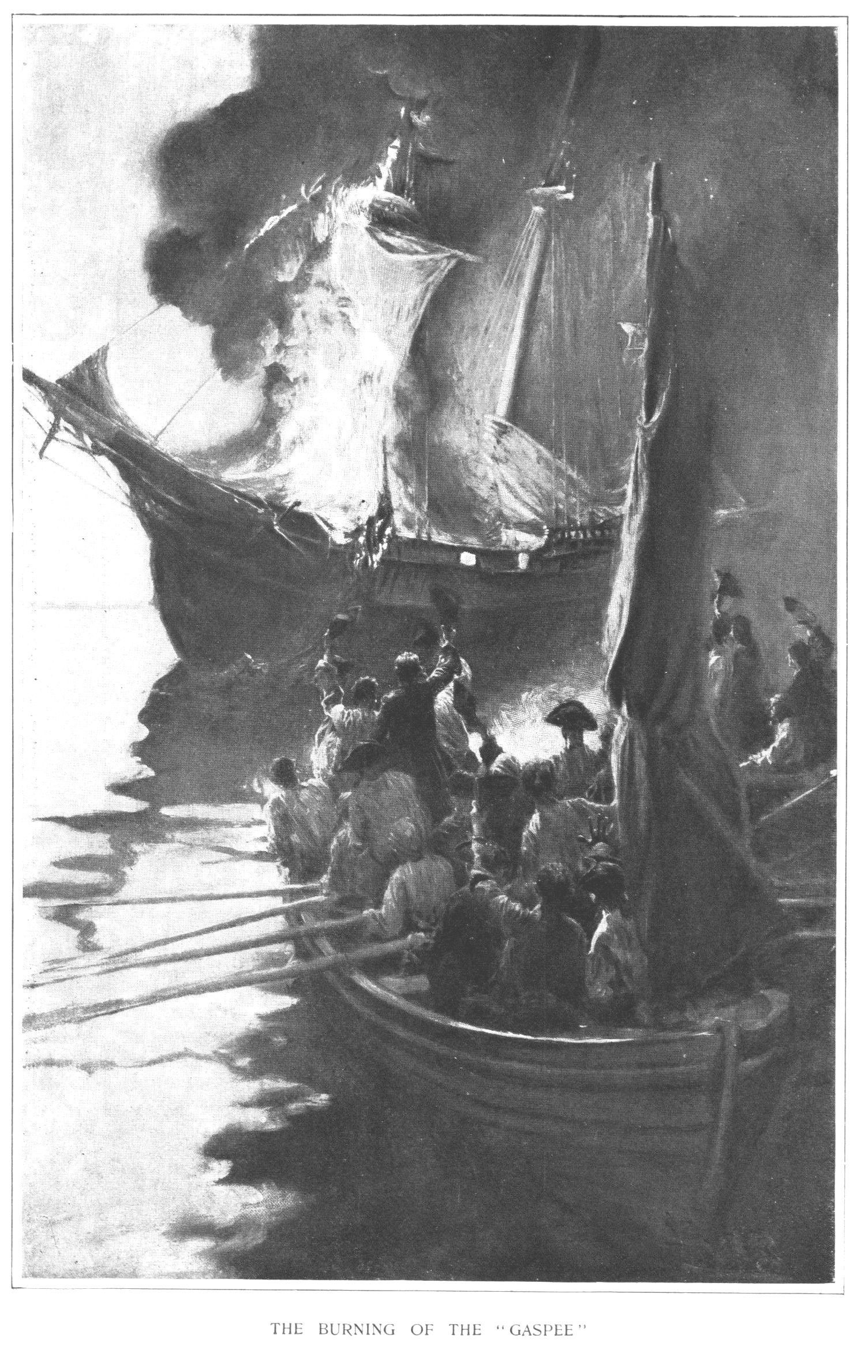 In Warwick and Cranston, Rhode Island, Gaspee Day commemorates the sinking of the HBMS Gaspee by Rhode Islanders in 1772. From Wikipedia:
That's the short version, be sure to go to Gaspee.org for MUCH MORE.In early 1772, Lieutenant William Dudingston sailed HBMS Gaspée into Rhode Island’s Narragansett Bay to aid in the enforcement of customs collection and inspection of cargo. Rhode Island had a reputation for smuggling and trading with the enemy during wartime. Dudingston and his officers quickly antagonized powerful merchant interests in the small colony. On June 9, the Gaspée gave chase to the packet boat Hannah, and ran aground in shallow water on the northwestern side of the bay. Her crew were unable to free her immediately, but the rising tide could allow the ship to free herself. A band of Providence members of the Sons of Liberty rowed out to confront the ship's crew before this could happen.[5]
At the break of dawn on June 10, the ship was boarded. The crew put up a feeble resistance and Lieutenant Dudingston was shot and wounded, and the vessel burned to the waterline.
And every year, about this time, we still hold the Gaspee Days Parade. Here are some pics (many more to be found at official websites):
The Kentish Guards


Minutemen (including Rehoboth)


Colonial Navy of Massachusetts


Ancient Mariners of Connecticut


The Patuxet Rangers


Friday, June 12, 2009
Spinning Rome
A couple years ago, while dismantling a piece of contemporary policy-wonkism, Jim McCormick explained Peter Heathers' Fall of the Roman Empire: A New History, and Bryan Ward-Perkins' The Fall of Rome and the End of Civilization thusly:
These books summarize the post-WW2 archaeology and literary analysis covering the late Roman and post-Roman periods, and offer a useful corrective to a more recent trend in scholarship which has created a soft-soaped "Late Antiquity" ... in competition to the "Dark Ages" of popular imagination. For these revisionist scholars of the last thirty years, the migration of barbarians into the Roman empire (both eastern and western branches) was both justifiable ("they only wanted the Roman good life") and relatively benign ("they settled in and became staunch allies"). Heather and Ward-Perkins discredit this post-modern, New Age image of the Fall very thoroughly but we shouldn't be surprised if major portions of Western academia and literati will choose to hold onto such a rosy-hued version of Roman/barbarian relations. If only the Romans had been nicer to the barbarians, they'll proclaim, so much unpleasantness could have been avoided.Recently, David Frum reviewed Adrian Goldworthy's How Rome Fell and also threw in the aforementioned books. He essentially agrees with McCormick:
The prevailing soft multiculturalism of our times has made the phrase “the fall of Rome” a surprisingly controversial one. It’s much preferred to talk about “transformation” rather than “decline and fall.” In this “transformationist” view, the High Classical period of 200 BCE-250 CE subsides gradually, almost imperceptibly into the “Late Antiquity” of CE 350-700. The barbarians did not invade; they migrated. Rome did not fall; it experienced a “fusion” with the new migrants in a “cross-cultural exchange.” (I am quoting here from the catalogue copy of a recent museum exhibition on the arts of Late Antiquity.)
I agree that there is a tangible post-modern influence upon the cultural equivalency revision from "invasion" to "accommodation". But both Frum and McCormick engage in oversimplification and caricature of the relevant--particularly recent--historiography to comment on contemporary times (McCormick more directly than Frum) . I'll stick with Ward-Perkins and Heather directly, who have more accurate analysis and assessment of the historiography (extended and edited excerpt):
HEATHER: The old view was essentially that internal decline had destroyed its capacity to resist: moral decadence, depopulation, lead poisoning, the debilitating effects of its recent conversion to Christianity, or another internal cause of your choice. It is important to remember that the Empire had always had important limitations....But all of this had always been true, and won’t explain the catastrophic collapse of the fifth century. In my view, the roots of collapse have to be sought in the outside world, among the barbarians. I should say that I use ‘barbarian’ here only in the sense of ‘outsider’ (one of its Roman connotations).
(snip)
I am entirely convinced by all the evidence that shows that the late Empire was not being torn apart by irrevocable processes of decline by the fourth century. Where I do part company with some revisionist scholarship, however, is over the argument that, because some Roman institutions ideologies and elites survived beyond 476, therefore the fall of the western Empire was not a revolutionary moment in European history. The most influential statement of this, perhaps, is Walter Goffart’s brilliant aphorism that the fall of the Western Empire was just ‘an imaginative experiment that got a little out of hand’. Goffart means that changes in Roman policy towards the barbarians led to the emergence of the successor states, dependent on barbarian military power and incorporating Roman institutions, and that the process which brought this out was not a particularly violent one.
To my mind, this view of the end of the Western Empire is deeply mistaken. Surely, there were plenty of Roman elements in the successor states, but one key institution was missing: the central authority structure of the Western Roman Empire itself. This had unified much of Western Europe for 500 years, but by 500 AD, had entirely ceased to exist.
WARD-PERKINS: When it comes to explaining the fall of the Western Roman Empire, we both believe that a series of unfortunate events was central to the story. Events (such as the arrival of the Huns), and chance play bigger parts in both our accounts, than deep structural weaknesses. I even argue that the eastern Roman Empire, which survived until Constantinople fell to the Turks in 1453, was saved, not because it was structurally stronger than the West, but mainly because it happened to have been dealt a favourable geographical hand. A thin band of sea separated and protected the heartlands of eastern prosperity (in Asia Minor and the Near East) from the barbarian-infested Balkans.
It is interesting that both of us should prioritize events and chance over structural change, because this seems to be the way that historians are moving right across the spectrum of historical thought. When I was a student, in the early seventies, we were all into profound structural changes, that swept people along inexorably; and we viewed events as banal and superficial. Nowadays (and probably it is just another fashion), individuals and concatenations of events, all of which might have gone differently, are seen as central to human history. In theory at least, according to modern thinking, I might be writing this sentence, not in England, but in a still-extant province of Britannia – if a few things had only gone better in the fifth century.
HEATHER: Here, there’s maybe a bit of difference between us because I do believe in the importance of structural change outside the Empire. It’s the argument I start to develop in the last chapter of my book, but much more elsewhere, namely that having to co-exist with a large and aggressive Empire pushes neighbouring populations into processes of socio-economic and political change, the end result of which is to generate societies more capable of parrying the Empire that started everything off. There is, in other words, a kind of Newton’s Third Law: to every Empire there is an opposite and equal reaction which undermines the preponderance of power in one locality on which the original Empire was based. This, in my view, is what happens in spades in the Near East with the Sassanians, and is already happening in important ways in non-Roman Europe, when the Huns come along to generate a precocious unity among the Germani. But, given enough time, the Germani might have got there anyway!
Sunday, June 07, 2009
Review: Horse Soldiers
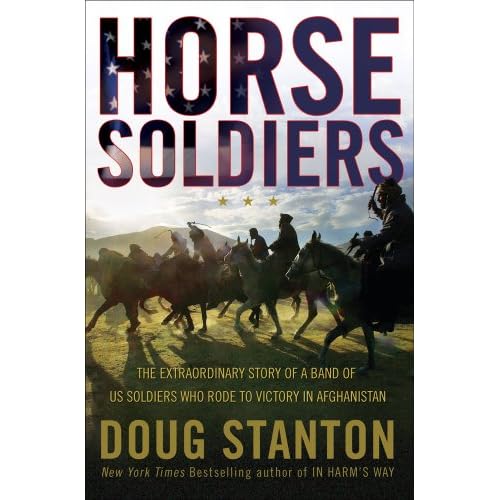
Doug Stanton, Horse Soldiers: The Extraordinary Stor of a Band of U.S. Soldiers Who Rode to Victory in Afghanistan.
Almost immediately after terrorists attacked American soil in September, 2001, members of the Army Special Forces began to prepare for entry into Afghanistan. While a nation sat shocked at the events of September 11th, these "silent warriors" relied on their own ingenuity and creativity to prepare for battle: Cold weather gear, batteries and modern GPS's were just a few of the things these warriors purchased on their own in the days leading up to their deployment. And their ability to improvise was a preview of what was to come in Afghanistan. As in past wars, no one had written a "how-to book" on war in Afghanistan. So the members of the Special Forces learned as they went along.
In a book full of characters, the journey of Special Forces Captain Mitch Nelson and the men under his command lay at the heart of the book, particularly the time Nelson spends with larger-than-life Afghani General Abdul Rashid Dostum. It is Dostum who shows Nelson the lay of the land in Afghanistan and who helps Nelson gain insight into the tribal/Warlord culture.
Throughout the book, Stanton illustrates the intricacies of Afghanistan's politics, such as how the leaders of the three rival factions of the Northern Alliance were fighting together while also positioning themselves politically and geographically for a peacetime nation. Stanton also shows the sort of deal-brokering that went on between the Taliban and the Northern Alliance, often facilitated by family and tribal ties. Dostum even mentioned to Nelson that sometimes he would go light on attacking the Taliban here or there if some of his men told him they had family in the opposing camp. In one instance, Dostum radioed the Taliban to tell them that he had Americans with him and that they were coming to get them!
For their part, the Special Forces, well trained in politics and technology, found one area in which they were unprepared: horsemanship. The Northern Alliance relied on actual horsepower on the battlefield. Stanton describes how, like warriors out of a bygone age, Afghani soldiers raced and rode at their mechanized Taliban opponents. And, with the help of well-targeted American bombs, they won the day.
Stanton doesn't focus solely on Nelson and Dostum. Several other members of the Special Forces have their stories told and one sub-plot involves the journey of the American Taliban, Johnny Walker Lindh, and how he ended up in Mazar-i-Sharif on the day 600 Taliban prisoners revolted. This last part of the book, which details the revolt and the attempt to take back the fort, is a clearly written and exciting read.
Stanton has produced a fine work of contemporary, boots-on-the-ground history. It's surprising that the story hadn't yet been told, but it was worth the wait. Now, onto the movie!
Friday, June 05, 2009
It doesn't seem as "old" when the pictures are in color
New color photos of Hitler have been released and are published in Life magazine.
As a kid who grew up (mostly) in the age of all-color TV, seeing anything in black and white--old pictures from the Civil War or old movies and news reels of WWII--seemed old or "other."But these color pictures and color movies of WWII and
and  similar images of early 20th century Russia (for instance), bring what had seemed remote historical events closer to our modern age.
And that makes the events and people of a bygone age more real, for good or ill.
As a kid who grew up (mostly) in the age of all-color TV, seeing anything in black and white--old pictures from the Civil War or old movies and news reels of WWII--seemed old or "other."But these color pictures and color movies of WWII
 and
and  similar images of early 20th century Russia (for instance), bring what had seemed remote historical events closer to our modern age.
And that makes the events and people of a bygone age more real, for good or ill.
Thursday, May 14, 2009
Looking for Popular Ideology in Ancient Rome
Mary Beard reviews T. P. Wiseman's Remembering the Roman People:
This book is ground-breaking for its simple suggestion that the ideology of Roman popular politics is not entirely lost to us, and for its virtuoso demonstration that, fragmentary, inadequate and intensively studied as our sources for the period are, they may still have more to tell us. Here as elsewhere, T. P. Wiseman offers us a view of late Republican Rome not preoccupied solely with elite self-interest, wealth and dignity – but where some voices still spoke out for equality, the sharing of wealth and land and for the rights of the common people.Sounds like sort of a mix of PoMo LitCrit and Intellectual history. Interesting.
Friday, March 13, 2009
Life on the Plantation
Rhode Island and Providence Plantations was established by Royal Charter in 1663:
But the point is that the "Plantations" referred to in the original charter was a common appellation for "a new settlement or colony". Obviously, the meaning of the word became associated with chattel slavery in the South and carries a negative connotation today. I completely understand that. But by pushing to remove "Providence Plantations" from the official name, by "changing that history", proponents are being anachronistic in their application of the term.
They are also being impractical in these times. Like other states, Rhode Island is facing some serious fiscal difficulties--there are plenty of things that our politicians should be worried about besides a feel-good measure of limited appeal and utility. In addition, there are costs incurred by such a change (there are many plaques, stationary, etc. that contain the full name, which would have to be changed).
One attractive argument for dropping the name is because it is so little-used and unknown. So what's the big deal, right? Well, there is the argument that this would be just the tip of the iceberg (ah yes, the "slippery slope." I know, I know...)
But allow me to indulge...What about the City of Providence. I think many people would associate the word "Providence" with religion and one of the definitions of "Providence" is "A manifestation of the care and superintendence which God exercises over his creatures; an event ordained by divine direction." The City of Providence is an official government entity. Should a government have a name that is so overtly religious? Or is that a history that needs to be changed, too?
Because titles to these lands rested only on Indian deeds, neighboring colonies began to covet them. To meet this threat, Roger Williams journeyed to England and secured a parliamentary patent in March 1643-44 uniting the four towns into a single colony and confirming his fellow settlers' land claims. This legislative document served adequately as the basic law until the Stuart Restoration of 1660 made it wise to seek a royal charter.To this day, the official name of the state is still the state of "Rhode Island and Providence Plantations", though the last half of the name has been forgotten by just about everyone for a very long time. Basically, the full name has been relegated to nothing but an interesting piece of trivia: the littlest U.S. state also has the longest name. So no one really thinks much about it. Well, except a few who want to officially drop the "Plantations."Dr. John Clarke was commissioned to secure a document from the new king, Charles II, that would both be consistent with the religious principles upon which the tiny colony was founded and also safeguard Rhode Island lands from encroachment by speculators and greedy neighbors. He succeeded admirably. The royal charter of 1663 guaranteed complete religious liberty, established a self-governing colony with local autonomy, and strengthened Rhode Island's territorial claims. It was the most liberal charter to be issued by the mother country during the entire colonial era, a fact that enabled it to serve as Rhode Island's basic law until May 1843.
Their history is correct. Newport was a major slave port and Charles Rappleye's Sons of Providence is a fine, recent work that covers both this and the role that the Brown family (founders of Brown University) had in the slave trade. In fact, Brown University has undergone a very public self-examination and has taken various steps to account for the fact that their foundations were built upon slavery. It is also true that some of the farms in the "South County" region of the state did operate with slave labor.A group of Smith Hill legislators, along with members of the black community, believe it’s time for a name change that does not conjure up images of the slave trade.
“That we still have the word ‘plantation’ in our name is really a grave injustice and an insult to people in our community,” said Sen. Harold M. Metts, D-Providence.
He and other legislators, reviving a decades-old proposal, have introduced companion bills in the House and Senate to place a question on the next election ballot that asks voters whether they want to change the state’s official name to “Rhode Island.”
In years past the proposal has gone nowhere, with critics saying that the state’s name –– however flawed –– is part of the fabric of the Ocean State’s history.
But supporters say otherwise.
“We’re part of history and we’re changing that history and we don’t want to see that name anymore,” said fellow sponsor Rep. Joseph Almeida, D-Providence, at a news conference yesterday.
The proposal is much bigger than a name change, they said. It’s about making the state aware of its ties to slavery and moving forward, free of that burden.
“If we look at history, history is written for us to avoid the past and to move on,” said Dennis Langley, executive director of the Urban League of Rhode Island.
In Narragansett County, conditions favored large-scale farming, and here more than anywhere else in the North a system began to emerge that looked like the Southern plantation colonies. In parts of "South Country" (as Narragansett also was called), one-third of the population was black work force by the mid-18th century. That's comparable to the proportion of slaves in the Old South states in 1820. Narragansett planters used their slaves both as laborers and domestic servants. William Robinson owned an estate that was more than four miles long and two miles wide, and he kept about 40 slaves there. Robert Hazard of South Kingstown owned 12,000 acres and had 24 slave women just to work in his dairy. The Stantons of Narragansett, who were among the province's leading landowners, had at least 40 slaves.
In keeping with the usual pattern, a higher percentage of blacks meant a more strict control mechanism. South Kingstown had perhaps the harshest local slave control laws in New England. After 1718, for instance, if any black slave was caught in the cottage of a free black person, both were whipped. After 1750, anyone who sold so much as a cup of hard cider to a black slave faced a crushing fine of £30.
But the point is that the "Plantations" referred to in the original charter was a common appellation for "a new settlement or colony". Obviously, the meaning of the word became associated with chattel slavery in the South and carries a negative connotation today. I completely understand that. But by pushing to remove "Providence Plantations" from the official name, by "changing that history", proponents are being anachronistic in their application of the term.
They are also being impractical in these times. Like other states, Rhode Island is facing some serious fiscal difficulties--there are plenty of things that our politicians should be worried about besides a feel-good measure of limited appeal and utility. In addition, there are costs incurred by such a change (there are many plaques, stationary, etc. that contain the full name, which would have to be changed).
One attractive argument for dropping the name is because it is so little-used and unknown. So what's the big deal, right? Well, there is the argument that this would be just the tip of the iceberg (ah yes, the "slippery slope." I know, I know...)
But allow me to indulge...What about the City of Providence. I think many people would associate the word "Providence" with religion and one of the definitions of "Providence" is "A manifestation of the care and superintendence which God exercises over his creatures; an event ordained by divine direction." The City of Providence is an official government entity. Should a government have a name that is so overtly religious? Or is that a history that needs to be changed, too?
Sunday, March 01, 2009
Review - Defying Empire:Trading with the Enemy in Colonial New York
Thomas M. Truxes - Defying Empire:Trading with the Enemy in Colonial New York
Everyone in colonial New York City traded with the enemy (the French) during the Seven Years' War (what we colonial descendants refer to as the French and Indian War). OK, that's an overstatement, but as Thomas Truxes fine work explains, it comes close to the truth. The City's merchants (obviously) and politicians (surprised?) were up to their necks in illegal trade before, during and after this period. "[T]rade with the enemy...did not flow from disloyalty to the Crown or indifference to the fate of the nation," writes Truxes, "...rather, the naked manifestation of a powerful commercial impulse synonymous with the great metropolis."
And while other colonies traded with the enemy--Connecticut and Rhode Island, for instance, were notorious for their "independence" in these matters--New York had distinct advantages when it came to "laundering" illegal goods. Its deep harbor and relatively small size made it easy for large ships to load and unload quickly and it had established itself since its days as a Dutch colony, as a key transshipment port.
During the war, New York's advantages as a supply depot for the British Royal Navy lent to its importance in colonial commerce and wartime machinations. This also made it an attractive target to the French, which, in turn, caused the British to increase the naval presence further. In addition, privateers from New York struck out to capture French prizes.
But there was money to be made by trading with the enemy, too. New York was both hub and spoke of illicit trade that went between Europe, the Caribbean islands and the colonies. Already established smuggling operations easily accommodated further illicit trade with the French. War or no war, they were well practiced at avoiding the authorities.
It certainly didn't help that many local politicians and crown representatives were in on the network. And, as others have argued, by the time the Crown, or Parliament, tried to do something, it was already too late. The horse was well out of the barn: these were the unfortunate rewards of so-called salutary neglect. As Truxes writes:
Everyone in colonial New York City traded with the enemy (the French) during the Seven Years' War (what we colonial descendants refer to as the French and Indian War). OK, that's an overstatement, but as Thomas Truxes fine work explains, it comes close to the truth. The City's merchants (obviously) and politicians (surprised?) were up to their necks in illegal trade before, during and after this period. "[T]rade with the enemy...did not flow from disloyalty to the Crown or indifference to the fate of the nation," writes Truxes, "...rather, the naked manifestation of a powerful commercial impulse synonymous with the great metropolis."
And while other colonies traded with the enemy--Connecticut and Rhode Island, for instance, were notorious for their "independence" in these matters--New York had distinct advantages when it came to "laundering" illegal goods. Its deep harbor and relatively small size made it easy for large ships to load and unload quickly and it had established itself since its days as a Dutch colony, as a key transshipment port.
During the war, New York's advantages as a supply depot for the British Royal Navy lent to its importance in colonial commerce and wartime machinations. This also made it an attractive target to the French, which, in turn, caused the British to increase the naval presence further. In addition, privateers from New York struck out to capture French prizes.
But there was money to be made by trading with the enemy, too. New York was both hub and spoke of illicit trade that went between Europe, the Caribbean islands and the colonies. Already established smuggling operations easily accommodated further illicit trade with the French. War or no war, they were well practiced at avoiding the authorities.
It certainly didn't help that many local politicians and crown representatives were in on the network. And, as others have argued, by the time the Crown, or Parliament, tried to do something, it was already too late. The horse was well out of the barn: these were the unfortunate rewards of so-called salutary neglect. As Truxes writes:
The flour act of 1757 was the sole piece of parliamentary legislation directed at Briton trading with the enemy during the Seven Years' War. If it was to be effective, the law would require broad support on both sides of the Atlantic. But the restrictions and penalties contained in the act applied only to colonial America. Cargoes dispatched from Great Britain and Ireland were unaffected. The discriminatory character of the act was immediately apparent. The ill-conceived legislation was one of the great blunders of the eighteenth-century British Parliament. Before a decade had passed, there would be others. (p.68)Truxes has conducted extensive research and it shows. He has a feel for the city at that time and also does a fine job explaining the relationships between various politicians and merchants. Indeed, through his explanation of both the geography and the personalities involved, he brings 1760's New York to life. He also provides a very good overview of the Caribean trade ports and, in general, this is a fine piecet of economic history. Further, it contributes to the historiography that supports the contention that it was Britain's reaction (or overreaction) to the conduct of its American colonists during the Seven Years' War that ultimately set the stage for the Revolution.
Monday, February 16, 2009
Rating the Presidents
CSPAN has another Presidential rating survey out. I don't have time for an extended "review" (well, frankly, my general response is "whatev"). But the two things I noticed were also noticed by KC Johnson at Cliopatria (thanks Ralph and sorry KC for initially giving the wrong attribution...sloppy of me). Why the hell does JFK rate so high, and why is Bill Clinton moving UP in these things? As KC points out:
Perhaps the most dubious rankings, however, involved the overall scores given to two recent Democrats, John Kennedy and Bill Clinton. Kennedy was ranked the sixth-best President, up from eighth in 2000. The two Presidents he surpassed between 2000 and 2009: Thomas Jefferson and Woodrow Wilson. In 2000, eighth seemed like a pretty high ranking for Kennedy, but it’s hard to justify placing him over two two-term chief executives with major accomplishments in both the foreign policy and domestic spheres.KC digs in a bit more and has some other questions, so check it out. Regardless, these things are obviously subjective. Though, the top two continue to be Lincoln and Washington. At least most can agree on that!
Monday, January 19, 2009
Al Queda Hit by the Plague?!
I couldn't pass up pointing to this story:
The disease, which struck Europe in the Middle Ages killing more than 25 million people, has swept through a training camp for insurgents in Algeria.
The arrival of the plague was discovered when security forces found the body of a dead terrorist by a roadside, the Sun reports.
The victim belonged to the large al-Qaeda network AQLIM (al-Qaeda in the Land of the Islamic Maghreb).
A security source told the paper: "This is the deadliest weapon yet in the war against terror. Most of the terrorists do not have the basic medical supplies needed to treat the disease.
"It spreads It spreads quickly and kills within hours. This will be really worrying al-Qaeda."
Black Death comes in various forms and was one of the deadliest pandemics in human history when it struck in the 1340s killing 75 million people across North Africa, Asia and Europe.
Bubonic Plague is spread by bites from infected rat fleas. Symptoms include painful boils in the groin, neck and armpits. In Pneumonic Plague, airborn bacteria spread like flu. Without medication it can be deadly.
The new epidemic began in the cave hideouts of AQLIM in Tizi Ouzou province, 150km east of the capital Algiers, the Sun reports.
The group, led by wanted terror figure Abdelmalek Droudkal, was forced to turn its shelters in the Yakouren forest into mass graves and flee.
The group now fears the highly-infectious disease could have spread to other al-Qaeda training camps or Taliban fighters in Afghanistan, the paper said.
A source said: "The emirs (leaders) fear surviving terrorists will surrender to escape a horrible death."
Monday, January 05, 2009
Review - The Threat Closer to Home: Hugo Chavez and the War Against America
Douglas E. Schoen and Michael Rowan, The Threat Closer to Home: Hugo Chavez and the War Against America.
In the Preface, Schoen and Rowan explain:
In the Introduction, they cover the "five critical fronts of Chavez's initiative against" the United States.
One of their concluding chapters is titled "Useful Idiots", in which they document the lengths to which intellectuals such as Noam Chomsky and Joseph Stiglitz as well as various activists and celebrities and, in particular, former President Jimmy Carter, have gone towards defending or turning a blind eye to Chavez's controversial policies and actions.
In their final chapter, "The Alliance of the Americas", the authors explain how Latin Americans still recent American intervention--both the government and corporations--into the region. They urge for a "post-Cold War, post-Monroe Doctrine relationship of equality with Latin Americans" as the only way to "make the United States a better nation." Clearly, they believe they have the best interests of Latin America in mind and their track record supports this and lends credence to their case against Chavez.
In the Preface, Schoen and Rowan explain:
It's important for us to set out this book--why we have spent the amount of time and effort that we have over the last few years writing about Hugo Chavez and working to change politics in Venezuela.The authors didn't just "parachute into" Venezuela, sniff around, dig up some dirt and produce an expose. They utilized their extensive experience and contacts in the nation to get to the heart of the problem posed by Hugo Chavez.
While admiring Chavez's intentions to eradicate poverty and corruption in his country, we have sadly come to believe that Chavez arguably presents a greater threat to America than Osama bin Laden does on a day-to-day basis, and this is our opportunity to set out the reasons why we believe this to be the case.
In the Introduction, they cover the "five critical fronts of Chavez's initiative against" the United States.
These are his oil; his alliance with Iran; the FARC's guerrilla war in Colombia; promoting anti-American states; and building friendly or so-called soft assets in the United States.The rest of the work is an amplification on these themes. They are astounded by those who justify his dictator-like actions because Chavez was democratically elected. Perhaps the first time, but not since, they argue. They cover familiar ground concerning how Chavez utilizes Venezuelan oil resources as an economic weapon, often to the detriment of his countrymen. They also explain and document his support of Islamist terrorists and contend the only explanation for such support would be "to harm the United States by any means at hand."
One of their concluding chapters is titled "Useful Idiots", in which they document the lengths to which intellectuals such as Noam Chomsky and Joseph Stiglitz as well as various activists and celebrities and, in particular, former President Jimmy Carter, have gone towards defending or turning a blind eye to Chavez's controversial policies and actions.
In their final chapter, "The Alliance of the Americas", the authors explain how Latin Americans still recent American intervention--both the government and corporations--into the region. They urge for a "post-Cold War, post-Monroe Doctrine relationship of equality with Latin Americans" as the only way to "make the United States a better nation." Clearly, they believe they have the best interests of Latin America in mind and their track record supports this and lends credence to their case against Chavez.
Subscribe to:
Posts (Atom)