Showing posts with label Terrorism. Show all posts

Sunday, June 07, 2009

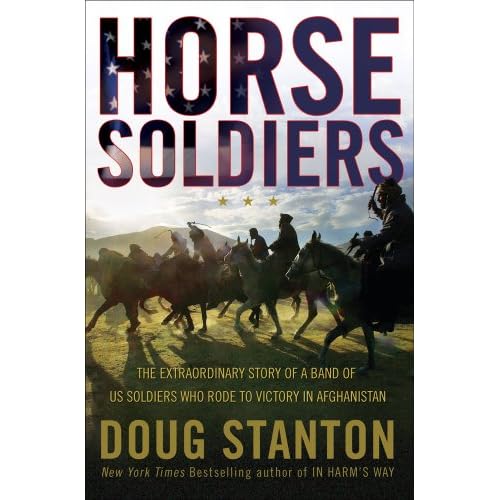
Review: Horse Soldiers


Doug Stanton, Horse Soldiers: The Extraordinary Stor of a Band of U.S. Soldiers Who Rode to Victory in Afghanistan.

Almost immediately after terrorists attacked American soil in September, 2001, members of the Army Special Forces began to prepare for entry into Afghanistan. While a nation sat shocked at the events of September 11th, these "silent warriors" relied on their own ingenuity and creativity to prepare for battle: Cold weather gear, batteries and modern GPS's were just a few of the things these warriors purchased on their own in the days leading up to their deployment. And their ability to improvise was a preview of what was to come in Afghanistan. As in past wars, no one had written a "how-to book" on war in Afghanistan. So the members of the Special Forces learned as they went along.

In a book full of characters, the journey of Special Forces Captain Mitch Nelson and the men under his command lay at the heart of the book, particularly the time Nelson spends with larger-than-life Afghani General Abdul Rashid Dostum. It is Dostum who shows Nelson the lay of the land in Afghanistan and who helps Nelson gain insight into the tribal/Warlord culture.

Throughout the book, Stanton illustrates the intricacies of Afghanistan's politics, such as how the leaders of the three rival factions of the Northern Alliance were fighting together while also positioning themselves politically and geographically for a peacetime nation. Stanton also shows the sort of deal-brokering that went on between the Taliban and the Northern Alliance, often facilitated by family and tribal ties. Dostum even mentioned to Nelson that sometimes he would go light on attacking the Taliban here or there if some of his men told him they had family in the opposing camp. In one instance, Dostum radioed the Taliban to tell them that he had Americans with him and that they were coming to get them!

For their part, the Special Forces, well trained in politics and technology, found one area in which they were unprepared: horsemanship. The Northern Alliance relied on actual horsepower on the battlefield. Stanton describes how, like warriors out of a bygone age, Afghani soldiers raced and rode at their mechanized Taliban opponents. And, with the help of well-targeted American bombs, they won the day.

Stanton doesn't focus solely on Nelson and Dostum. Several other members of the Special Forces have their stories told and one sub-plot involves the journey of the American Taliban, Johnny Walker Lindh, and how he ended up in Mazar-i-Sharif on the day 600 Taliban prisoners revolted. This last part of the book, which details the revolt and the attempt to take back the fort, is a clearly written and exciting read.

Stanton has produced a fine work of contemporary, boots-on-the-ground history. It's surprising that the story hadn't yet been told, but it was worth the wait. Now, onto the movie!

Monday, January 19, 2009

Al Queda Hit by the Plague?!

I couldn't pass up pointing to this story:

The disease, which struck Europe in the Middle Ages killing more than 25 million people, has swept through a training camp for insurgents in Algeria.

The arrival of the plague was discovered when security forces found the body of a dead terrorist by a roadside, the Sun reports.

The victim belonged to the large al-Qaeda network AQLIM (al-Qaeda in the Land of the Islamic Maghreb).

A security source told the paper: "This is the deadliest weapon yet in the war against terror. Most of the terrorists do not have the basic medical supplies needed to treat the disease.

"It spreads It spreads quickly and kills within hours. This will be really worrying al-Qaeda."

Black Death comes in various forms and was one of the deadliest pandemics in human history when it struck in the 1340s killing 75 million people across North Africa, Asia and Europe.

Bubonic Plague is spread by bites from infected rat fleas. Symptoms include painful boils in the groin, neck and armpits. In Pneumonic Plague, airborn bacteria spread like flu. Without medication it can be deadly.

The new epidemic began in the cave hideouts of AQLIM in Tizi Ouzou province, 150km east of the capital Algiers, the Sun reports.

The group, led by wanted terror figure Abdelmalek Droudkal, was forced to turn its shelters in the Yakouren forest into mass graves and flee.

The group now fears the highly-infectious disease could have spread to other al-Qaeda training camps or Taliban fighters in Afghanistan, the paper said.

A source said: "The emirs (leaders) fear surviving terrorists will surrender to escape a horrible death."

Sunday, August 10, 2008

Review: Your Government Failed You

Richard Clarke, Your Government Failed You: Breaking the Cycle of National Security Disasters
Your government failed you.
So said Richard Clarke to the American people during the 9/11 Commission hearings a few years back. Clarke's resume of over 30 years in the foreign policy arena speaks for itself and adds weight to his point of view. At times, his tales of frustration infuriate because they show just how much government did fail leading up to 9/11.

But, as reaction to his first book Against All Enemies: Inside America's War on Terror made evident, he can also be frustrating to those who are familiar with events he describes. And this familiarity with acute events can lead, ultimately, to a wholesale--albeit unwarranted--distrust of Clarke.

If I know that he's not being completely forthcoming on Event "A" for which I know a lot about, then how can I be sure he's not doing the same for Events "B, C and D" for which I'm not as familiar? And to the degree that his diagnoses and prescriptions rely upon his experience and expertise, as supported by his explanation of various events, then how seriously am I to take his ideas? In other words, are Clarke's ideas well-informed and worthwhile or just part of an exercise in legacy-protection? The answer, unsurprisingly, is all of the above.

When reading and analyzing a first-hand account of events, a reader should always be on the look out for bias; on the part of both the source and the reader. Ultimately, each of us have to rely on our sense of what seems like good, sound reasoning and argumentation. So, despite these reservations, there are still some things that even those most predisposed to distrust him can learn from Clarke.

Throughout Your Government Failed You, Clarke clearly names names and assesses blame. His reasoning seems sound and his grasp of the nuances of foreign affairs and diplomacy is worth noting as is his recognition of the role that contingency can play in outcomes. And while he doesn't let himself off the hook for some of the errors made, his phraseology can be passive/aggressive. For instance, the phrasing of his "apology" that gave title to this book leaves the impression that he's apologizing more for others than himself. In his opening to Chapter 5, Clarke explains that on the morning of 9/11
I knew that I had failed. In the days and years leading up to that awful moment I had failed to persuade two administrations to do enough to prevent the attacks that were now happening around me.
You see, the decision makers in government didn't listen to Clarke, which is why they failed. And he only failed because they didn't listen. That's a fairly obtuse way of taking blame. The question is then: should we listen to him? Based on my reading and analysis of the events that Clarke describes, I certainly am wary of accepting Clarke's version of events prima facia.

For instance, he notes "the refusal of the Bush administration to ratify the [Kyoto] protocol...(p.277)" and makes no mention of the Clinton administrations similar "refusal." Elsewhere, he explains how he thinks partisanship is bad for national security, something for which many would agree. But the examples of partisanship he provides are markedly one-sided.
I think the record is fairly indisputable that national security issues have been used for partisan electoral advantage in recent years: terrorism threats have been overhyped near elections, predictions have been made about terrorist attacks occurring if the other party wins, people's patriotism has been questioned. (p.340-41)
Common charges levied against the Republicans, all. No mention of the political rhetoric flying from the Democratic side--immediate withdrawal, illegal war, the Bush fascist state, etc.--which helped them sweep to Congressional power in 2006. I suppose if you believe one set of arguments, then they aren't partisan?

Much of the first part of the book is devoted to Clarke's restatement of many of the same charges he made in Against All Enemies. He still thinks Iraq is a distraction away from Afghanistan, which is an arguable point, especially with Osama bin Laden still loose. He also puts much blame for Iraq at the feet of the generals charged with preparing our forces for the invasion:
1) "Neither the Chairman of the Joint Chiefs of Staff [General Richard Myers] nor the regional commander at CENTCOM [General Tommy Franks] dissented from the initial war plan..."
2) The generals didn't implement proper counter-insurgency activities though they were aware of analysis from the CIA and State department that predicted insurgent activity in post-invasion Iraq.
3) Related to #2, once it became clear that the President intended to invade Iraq, the Generals did not advise the President and Congress that they did not have enough troops to deal with an insurgency.
4) "Inadequate training and...equipment" for American troops in Iraq.
5) Generals tacitly condoned torture, such as at Abu Grahib.
6) Generals didn't ensure that wounded troops were treated adequately (Walter Reed).
All of these points are worth debating. But elsewhere, Clarke essentially accuses General David Petraeus, architect of the proving-successful surge implemented in 2007, of moving the goalposts himself when his own counter-insurgency efforts were initially exhibiting slow returns. "It began to seem as if the reason for the surge, in Petraeus's mind, was to prove that his new counterinsurgency strategy could work."

The recent success in Iraq is making Clarke a victim of the time line. For he claims that Petraeus
[b]y defending a policy that in the larger sense was injurious to the United States and the Army, by arguing for staying on when he admitted that his own condition for the U.S. presence (real progress toward Iraqi unity) was not being met...raised new questions about what makes a general political.
When Clarke wrote these words, the effectiveness of the surge was still in doubt. But no matter the expertise that lay on the side of the predictor, reality has a way of ruining predictions.

Clarke has much else to say about a plethora of items related to national security and, not as impressively, global warming. As to the last, he essentially toes the Al Gore line. Nothing earth shattering (or warming?).

Further, it becomes clear that Clarke is a supporter of the Powell doctrine, though redefined for the times, which is entirely defensible. On the other hand, he also channels Thomas Franks (the academic, not the general) by basically asking "what's the matter with the military," because he can't understand why they have become so overwhelmingly Republican (though he notes that Democrats are gaining support).

All in all, this is a "thick" book. There is a lot to digest and a lot to think about. Clarke's writing isn't florid or light. Instead, he hits you time and again with anecdotes and antidotes that spring from the mind of the man who apologized to the American people on behalf of the U.S. Government. In the end, his is a voice that warrants a listen. Perhaps the best way to get a balanced view of some of the events is to read Clarke's book in combination with Douglas Feith's War and Decision. To quote Ronald Reagan, "Trust, but verify."

Thursday, August 07, 2008

Going to School on the Barbary Wars

I've done a few substantive posts about the Barbary Wars in the past. Michael Medved is the latest (here's another) to use them to buttress his particular position in contemporary arguments about the War in Iraq and the GWOT. Here are his 7 points.
1. The U.S. often goes to war when it is not directly attacked. One of the dumbest lines about the Iraq War claims that “this was the first time we ever attacked a nation that hadn’t attacked us.” Obviously, Barbary raids against private shipping hardly constituted a direct invasion of the American homeland, but founding fathers Jefferson and Madison nonetheless felt the need to strike back. Of more than 140 conflicts in which American troops have fought on foreign soil, only one (World War II, obviously) represented a response to an unambiguous attack on America itself. Iraq and Afghanistan are part of a long-standing tradition of fighting for U.S. interests, and not just to defend the homeland.

2. Most conflicts unfold without a Declaration of War. Jefferson informed Congress of his determination to hit back against the North African sponsors of terrorism (piracy), but during four years of fighting never sought a declaration of war. In fact, only five times in American history did Congress actually declare war – the War of 1812, the Mexican War, The Spanish American War, World War I and World War II. None of the 135 other struggles in which U.S. troops fought in the far corners of the earth saw Congress formally declare war—and these undeclared conflicts (including Korea, Vietnam, the First Gulf War, and many more) involved a total of millions of troops and more than a hundred thousand total battlefield deaths.

3. Islamic enmity toward the US is rooted in the Muslim religion, not recent American policy. In 1786, America’s Ambassador to France, Thomas Jefferson, joined our Ambassador in London, John Adams, to negotiate with the Ambassador from Tripoli, Sidi Haji Abdrahaman. The Americans asked their counterpart why the North African nations made war against the United States, a power “who had done them no injury", and according the report filed by Jefferson and Adams the Tripolitan diplomat replied: “It was written in their Koran, that all nations which had not acknowledged the Prophet were sinners, whom it was the right and duty of the faithful to plunder and enslave; and that every mussulman who was slain in this warfare was sure to go to paradise.”

4. Cruel Treatment of enemies by Muslim extremists is a long-standing tradition. In 1793, Algerian pirates captured the merchant brig Polly and paraded the enslaved crewmen through jeering crowds in the streets of Algiers. Dey Hassan Pasha, the local ruler, bellowed triumphantly: “Now I have got you, you Christian dogs, you shall eat stones.” American slaves indeed spent their years of captivity breaking rocks. According to Max Boot in his fine book The Savage Wars of Peace: “A slave who spoke disrespectfully to a Muslim could be roasted alive, crucified, or impaled (a stake was driven through the arms until it came out at the back of the neck). A special agony was reserved for a slave who killed a Muslim – he would be cast over the city walls and left to dangle on giant iron hooks for days before expiring of his wounds.”

5. There’s nothing new in far-flung American wars to defend U.S. economic interests. Every war in American history involved an economic motivation – at least in part, and nearly all of our great leaders saw nothing disgraceful in going to battle to defend the commercial vitality of the country. Jefferson and Madison felt no shame in mobilizing – and sacrificing – ships and ground forces to protect the integrity of commercial shipping interests in the distant Mediterranean.

Fortunately for them, they never had to contend with demonstrators who shouted “No blood for shipping!”

6. Even leaders who have worried about the growth of the U.S. military establishment came to see the necessity of robust and formidable armed forces. Jefferson and Madison both wanted to shrink and restrain the standing army and initially opposed the determination by President Adams to build an expensive new American Navy. When Jefferson succeeded Adams as president, however, he quickly and gratefully used the ships his predecessor built. The Barbary Wars taught the nation that there is no real substitute for military power, and professional forces that stand ready for anything.

7. America has always played “the cop of the world.” In part, Jefferson and Madison justified the sacrifices of the Barbary Wars as a defense of civilization, not just the protection of U.S. interests – and the European powers granted new respect to the upstart nation that finally tamed the North African pirates. Jefferson and Madison may not have fought for a New World Order but they most certainly sought a more orderly world. Many American conflicts over the last 200 years have involved an effort to enfort to enforce international rules and norms as much as to advance national interests. Wide-ranging and occasionally bloody expeditions throughout Central America, China, the Philippines, Africa and even Russia after the Revolution used American forces to prevent internal and international chaos.

Thursday, April 26, 2007

Hitchens on Jefferson and the Pirates

Christopher Hitchens has written a good piece on Thomas Jefferson and the Barbary Pirates. I've spent some time on the Barbary Pirates myself and there are a few things in the Hitchen's piece with which I'd quibble, but not right now. Here's the important point:

Perhaps above all, though, the Barbary Wars gave Americans an inkling of the fact that they were, and always would be, bound up with global affairs. Providence might have seemed to grant them a haven guarded by two oceans, but if they wanted to be anything more than the Chile of North America—a long littoral ribbon caught between the mountains and the sea—they would have to prepare for a maritime struggle as well as a campaign to redeem the unexplored landmass to their west. The U.S. Navy’s Mediterranean squadron has, in one form or another, been on patrol ever since.

And then, finally, there is principle. It would be simplistic to say that something innate in America made it incompatible with slavery and tyranny. But would it be too much to claim that many Americans saw a radical incompatibility between the Barbary system and their own? And is it not pleasant when the interests of free trade and human emancipation can coincide?

Wednesday, December 20, 2006

Scapegoating

As I recently blathered on about, I think that part of being a "good" historian is to tone down the rhetoric and hyperbole while debating both the historical and contemporary. Also, it is also wise to avoid getting sucked into believing that there are always simple (reductionist) explanations for historical causation. Add to these the related temptation of scapegoating as explained by Mary Eberstadt.
... a flight from political reality has indeed been underway on both the left and the right in America in the years since that event, as well as accelerating into more advanced forms in much of Europe. To switch metaphors, in the wake of the 9/11 attack -- and later, related Islamist attacks on civilians, most notably in Spain and Britain -- many Western observers have responded not by absorbing what we now know to be true about our world, but rather by transposing those brute facts into other, safer, more familiar keys.
In other words, instead of focusing on the potential world-changing force that is radical Islam, many in the west are taking a sort of perverse comfort in turning towards familiar scapegoats.

Eberstadt explains that some on the right have taken to blaming "immigrants" for all of America's ills, while some on the left (including some libertarian's) have glommed onto the idea that "christianists" and/or "fundamentalists" are marching America toward Gomorrah. Then there is the popular Bush scapegoat, which many in the general public and the intellectual class find particularly appealling. But, Eberstadt explains, there are problems with this:
[One example is] Frank Rich's The Greatest Story Ever Sold: The Decline and Fall of Truth from 9/11 to Katrina (Penguin Press). Like so much else now dominating the nonfiction aisles, it apprehends one large truth -- that the current balance between reality and rhetoric has been altered in a way deleterious to us. It then scrambles that message, again like the other scapegoaters, into a version more palatable than what the actual one would require. In this case, the scramble ends in focusing blame and hatred onto one single man -- George Bush -- who also shares a key feature of attraction alongside other scapegoats: He is not going to strike back.

Like others who are Bush-haters simpliciter, Rich is too bilious to make a systematic argument. The result is a burning effigy of a book whose smoke obscures one fundamental point: Whatever else George W. Bush is about, what the record does seem to show and what even many of his enemies feel forced to concede is that he does actually believe in what he is doing. Because it can't allow itself to go there, The Greatest Story Ever Sold becomes as two-dimensional as its subject...

The trouble with putting Bush personally at the center of what ails us is much like the related trouble of relocating the illegals or the theocrats there instead: i.e., it tries to explain too much. In this, too, the parallelism of the scapegoats can be seen. He is a child of privilege who believes in nothing. No, he is an ideological Christian possessed of an unwavering and therefore dangerous faith. Which is it? He is a tool of the oil interests, of the neoconservatives, of the Christians; no, he is a puppet master of them all; no again, he is himself a puppet of Karl Rove. He is "someone who likes to compete and win at all costs" (Frank Rich); he is someone who has had everything handed to him and doesn't know what it is like to struggle (also Rich). And so on.
There are also those--Eberstadt points to a recent issue of Foreign Affairs--who have concluded that "9/11 was not that big a deal after all." Then there is Europe, which has closed its eyes to the Islamist threat in its own backyard and instead resorted to a ramping up of anti-American rhetoric. Yet, Eberstadt thinks that anti-Americanism may be nothing more than misplaced anger:
Perhaps these days, on the Continent, the widespread, all-explaining urge to lay everything at the door of the U.S. has little to do with America proper. Perhaps it does not have much to do either with the post-Cold War unipolar world. Perhaps it is not even really about Iraq.

No, perhaps the anti-Americanism of today is best understood instead as a way of being furious in public with somebody for the insecurities and anxieties wrought by Islamist terrorism in this world, including in increasingly Muslim Europe -- an option made even more attractive by the safe bet that Americans, unlike some other people, are unlikely to respond to this rhetoric, let alone to editorial cartoons, by burning cars, slitting throats, or issuing death threats in places like Paris and Amsterdam and Regensburg and London.

In the end, people are comfortable with scapegoats because they can understand them. They are "problems" that have been solved before. Throw out the illegals, demonize the motives of religious people, blame Bush or America for everything or put our head in the sand. All are easier than dealing with an entity that simply doesn't think about life and society like the West.

Tuesday, December 19, 2006

American Historical Association Against the War

Historians Against the War is going to present a resolution at the Business Meeting of the annual American Historical Association confab in Atlanta. Here's the proposed resolution:
Resolution on United States Government Practices Inimical to the Values of the Historical Profession (this resolution did not appear in the print version of the December Perspectives)

Whereas, The American Historical Association’s Statement on Standards of Professional Conduct emphasize the importance of open inquiry to the pursuit of historical knowledge;

Whereas, the American Historical Association adopted a resolution in January 2004 re-affirming the principles of free speech, open debate of foreign policy, and open access to government records in furthering the work of the historical profession;

Whereas during the war in Iraq and the so-called war on terror, the current Administration has violated the above-mentioned standards and principles through the following practices:
*excluding well-recognized foreign scholars;
*condemning as “revisionism” the search for truth about pre-war intelligence;
*re-classifying previously unclassified government documents;
*suspending in certain cases the centuries-old writ of habeas corpus and substituting indefinite administrative detention without specified criminal charges or access to a court of law;
*using interrogation techniques at Guantanamo, Abu-Ghraib, Bagram, and other locations incompatible with respect for the dignity of all persons required by a civilized society;

Whereas a free society and the unfettered intellectual inquiry essential to the practice of historical research, writing, and teaching are imperiled by the practices described above; and

Whereas, the foregoing practices are inextricably linked to the war in which the United States is presently engaged in Iraq; now, therefore, be it

Resolved, That the American Historical Association urges its members through publication of this resolution in Perspectives and other appropriate outlets:

  1. To take a public stand as citizens on behalf of the values necessary to the practice of our profession; and

  2. To do whatever they can to bring the Iraq war to a speedy conclusion.
Now, it is curious that the "anti-war" resolution was somehow left out of the printed version of Perspectives, the AHA's monthly magazine while a rather mundane Informed Meetings Exchange resolution and a more important (and less controversial) "Resolution Opposing the Use of Speech Codes to Restrict Academic Freedom" were included. But I don't want to conspiracy monger...perhaps there was a technical delay or something.

I added the hyperlinks in a good faith effort to help explain the "story" that lay behind some of the specific charges. Specifically, I can understand why the AHA would be concerned with the first three issues listed as justifications for part 1. of the resolution. But I don't get the particular significance that the 4th and 5th justifications--in concert with part 2 of the resolution--have to practising History. Don't get me wrong, the AHA and its memebers have every right to make a political statement, but, to put it bluntly, I don't think anyone particularly cares whether or not the AHA wants people "[t]o do whatever they can to bring the Iraq war to a speedy conclusion." In fact, I doubt if most people find the AHA any more or less worth listening to on the subject. To Joe Sixpack, this statement is about as relevant as if the local little league said the same thing. Just another bunch of pointy-heads throwing in their 2 cents. But I guess if it makes everyone feel good...

Tuesday, November 28, 2006

A Consensus on Un-serious Europe

Left, Right and Center agree, European leaders are a bunch of unserious wannabes:

MARA LIASSON: [T]he U.S. wants the European and other NATO countries to pony up more. That's, I think, been a perennial problem. You and I have covered a lot of summits where the Europeans talk big, they want to be a counterweight to the United States, but as you heard Nick Burns just say, they're not willing to spend the proportion of their GDP on defense the way we do.

MORT KONDRACKE: The United States spends about 3.8 percent of GDP on defense, the whole rest of NATO spends 1.9 percent. . . . And our friends, the French, you know, have specifically refused to get involved in Afghanistan. They've got 20,000 men that they have on standby duty for use someplace, and when they were asked specifically to join up and go help out in Afghanistan, they said, "No, we're going to hold these back in case they're needed in Kosovo." You know, typically French.

BARNES: [T]he Germans, the Italians and the Spanish, even when they come, they have a rule. No combat. They don't want to fight. So it's left to the Americans, the Canadians, and the Dutch, actually, are pretty good. And then the Australians, who aren't even members of NATO are the ones who are actually doing the fighting. And the Canadians have lost 34 soldiers in recent months, so they've really done a good job.

Look, the Europeans have been free-riders now for 60 years. It's going to are hard to get them off the dole, it really is. And it'll almost be small amounts of money, percentage-wise. [bold from NRO]


OK, I know I'm immediately endangering any credibility I may have with many because this comes from FOX (evil evil evil) via NRO (evil evil evil), but frankly, I don't care. So what if these observations were made on FOX, the comments all ring true to me and it's not like it's the first time similar points have been made (here, here, here). However, the wonderful succinctness of the above is that we have someone from Left (Liasson), Middle (Kondracke) and Right (Barnes) all agreeing that "Europe"--that generalized group of nations that is comprised mostly of the Cold War "west"--talks big and carries a twig.
Not all of them, to be sure, but too many of them.

Saturday, November 25, 2006

Dershowitz Takes President Carter to Task

In "The World According to Carter," Alan Dershowitz (via ALD) finds much wrong with President Jimmy Carter's "ahistorical" retelling of the Israeli/Palestinian conflict that runs through the former President's new book, Palestine: Peace Not Apartheid.

Sometimes you really can tell a book by its cover. President Jimmy Carter's decision to title his new anti-Israel screed "Palestine: Peace Not Apartheid" (Simon & Schuster, 288 pages, $27) tells it all. His use of the loaded word "apartheid," suggesting an analogy to the hated policies of South Africa, is especially outrageous, considering his acknowledgment buried near the end of his shallow and superficial book that what is going on in Israel today "is unlike that in South Africa—not racism, but the acquisition of land." Nor does he explain that Israel's motivation for holding on to land it captured in a defensive war is the prevention of terrorism. Israel has tried, on several occasions, to exchange land for peace, and what it got instead was terrorism, rockets, and kidnappings launched from the returned land.

In fact, Palestinian-Arab terrorism is virtually missing from Mr. Carter's entire historical account, which blames nearly everything on Israel and almost nothing on the Palestinians...There is no mention of the long history of Palestinian terrorism before the occupation, or of the Munich massacre and others inspired byYasser Arafat. There is not even a reference to the Karine A, the boatful of terrorist weapons ordered by Arafat in January 2002.

Mr. Carter's book is so filled with simple mistakes of fact and deliberate omissions that were it a brief filed in a court of law, it would be struck and its author sanctioned for misleading the court. Mr. Carter too is guilty of misleading the court of public opinion. A mere listing of all of Mr. Carter's mistakes and omissions would fill a volume the size of his book.
After listing a few of the "mistakes and omissions," Dershowitz continues:

And it's not just the facts; it's the tone as well. It's obvious that Mr. Carter just doesn't like Israel or Israelis. He lectured Golda Meir on Israeli's "secular" nature, warning her that "Israel was punished whenever its leaders turned away from devout worship of God." He admits that he did not like Menachem Begin. He has little good to say about any Israelis — except those few who agree with him. But he apparently got along swimmingly with the very secular Syrian mass-murderer Hafez al-Assad. Mr. Carter and his wife Rosalynn also had a fine time with the equally secular Arafat — a man who has the blood of hundreds of Americans and Israelis on his hands:

Rosalynn and I met with Yasir Arafat in Gaza City, where he was staying with his wife, Suha, and their little daughter. The baby, dressed in a beautiful pink suit, came readily to sit on my lap, where I practiced the same wiles that had been successful with our children and grandchildren. A lot of photographs were taken, and then the photographers asked that Arafat hold his daughter for a while. When he took her, the child screamed loudly and reached out her hands to me, bringing jovial admonitions to the presidential candidate to stay at home enough to become acquainted with is own child.

There is something quite disturbing about these pictures.

"Palestine: Peace Not Apartheid" is so biased that it inevitably raises the question of what would motivate a decent man like Jimmy Carter to write such an indecent book. Whatever Mr. Carter's motives may be, his authorship of this ahistorical, one-sided, and simplistic brief against Israel forever disqualifies him from playing any positive role in fairly resolving the conflict between Israel and the Palestinians. That is a tragedy because the Carter Center, which has done much good in the world, could have been a force for peace if Jimmy Carter were as generous in spirit to the Israelis as he is to the Palestinians.

Friday, September 15, 2006

What's the Historical Value of Path to 9/11

After examining the "mainstream" debate during the run-up to the actual showing of Path to 9/11 (here and here), I have to wonder what historians think of it now that it has actually aired. Truth be told, I haven't seriously looked for--nor have I really run across in my daily blog travels--any post mortems on Path in the history blogosphere. Now that historians have had the opportunity to see it, they don't seem to have written about it anywhere near as much as they did when they hadn't seen it. Hm. Well, here's my take.

First, I believe that--in a very idealistic sense--Path to 9/11 was a missed opportunity. As I mentioned in a previous post, Dale Franks' observation that "Fake but Accurate" isn't good enough and that if the filmakers had simply "hew[ed] tightly to the 9/11 Commission's report, they could have stood their ground firmly on the basis of the film's historical accuracy." That being said, while it was indeed a docudrama and some characters were amalgamations and there was "time compression", the overall theme was accurate: government and the bureaucracies that compose it are ill-suited to "think outside of the box" and take action.

Path showed that our government was still fighting the last war (or not--post-Cold War, etc.). Terrorism was regarded as a legal problem and the solutions formulated to deal with it based on that philosophy proved to be unsatisfactory and ineffective. Within that framework, those in power--the members of the Clinton and Bush administrations--were simply not able to imagine the level to which Al Queda was willing and able to take their (at the time) one-sided war. The quick take away: bureaucracies don't change very fast or very well.

Whether or not Path can be used by historians in relation to its acute subject matter--does it have any historical value in explaining the path to 9/11--seems less important than how it can be used as an example in explaining a broader historical problem. Namely, no matter how accurate a document is in depicting actual events, historians (and everyone else) must be careful in how they criticize historical actors for decisions they made without the benefit of the hindsight that we posess in the here-and-now.

Wednesday, September 13, 2006

"Assessing the Islamist Threat"

The Moslem world sprawls around half the east, from the Pacific across Asia and Africa to the Atlantic, along one of the greatest of trade routes; in its center is an area extremely rich in oil; over it will run some of the most strategically important air routes.

With few exceptions, the states which it includes are marked by poverty, ignorance, and stagnation. It is full of discontent and frustration, yet alive with consciousness of its inferiority and with determination to achieve some kind of general betterment.

Two basic urges meet head-on in this area, and conflict is inherent in this collision of interests. These urges reveal themselves in daily news accounts of killings and terrorism, of pressure groups in opposition, and of raw nationalism and naked expansionism masquerading as diplomatic maneuvers. The urges tie together the tangled threads of power politics which—snarled in the lap of the United Nations Assembly—lead back to the centers of Islamic pressure and to the capitals of the world's biggest nations.

The first of these urges originates within the Moslems' own sphere. The Moslems remember the power with which once they not only ruled their own domains but also overpowered half of Europe, yet they are painfully aware of their present economic, cultural, and military impoverishment. Thus a terrific internal pressure is building up in their collective thinking. The Moslems intend, by any means possible, to regain political independence and to reap the profits of their own resources, which in recent times and up to the present have been surrendered to the exploitation of foreigners who could provide capital investments. The area, in short, has an inferiority complex, and its activities are thus as unpredictable as those of any individual so motivated.

The other fundamental urge originates externally. The world's great and near-great powers cover the economic riches of the Moslem area and are also mindful of the strategic locations of some of the domains. Their actions are also difficult to predict, because each of these powers sees itself in the position of the customer who wants to do his shopping in a hurry because he happens to know the store is going to be robbed.
Thus says a report just published in the Middle East Quarterly.

It was written in 1946.

Tuesday, September 12, 2006

Civil Discourse

InstapunK (via Glenn Reynolds) asks some important questions of all of us regarding the too-often nasty and hyperbolic nature of post-9/11 criticisms and second-guessing of President Bush.
What would the past five years have been like, I couldn't help wondering, if debate and criticism had proceeded atop the civil platform of agreement that the President was really trying to do his best in a terrible crisis that almost no one had anticipated? Imagine that everyone had been sober and serious all along, as if the responsibility were theirs and not someone else's. Imagine that the opposition to the administration's policies had been more substantive than personal, focused on alternative proposals rather than autopsies of irrevocable decisions past. Imagine that all of us were dealing with today's reality instead of pet grievances from months or years ago. Isn't it possible that the critics might have had more impact on events, that the defenders of American policy might have listened and responded more thoughtfully?

You can decide all these questions for yourselves, but I know I would have been more open to opposing views if their proponents had not insisted that doing the right thing required a first step of denouncing the president as a fool, a liar, an opportunist, and a closet tyrant. If I put aside the partisan emotions such postulates inspire, I have enough breathing room to perceive that my own views have changed again and again over the past five years...

Only one of the 300 million people who live in America wake up every day to a briefing from the nation's intelligence agencies about what threats might become reailty today. That's a fact. The man's name is George W. Bush.

I'm NOT saying this makes him immune from criticism. In fact, the exact opposite is true. Forget all the invective about his cowardice or shirking of military duty when he was a twenty-something. Five years of such briefings would be enough to give most of us Post-Traumatic Stress Disorder. It's probably the case that the President of the United States has been damaged by what he's been through. It's the most obvious explanation conceivable for why the White House seems so slow to respond to the daily firestorms the mass media engender. My guess is, not too many of us would want to be living inside George W. Bush's head right now. It's too much. For anyone. He needs advice and constructive criticism and thoughtful opposition. But who -- and I'm including all of you in this -- is served by characterizing the advice, criticism, and opposition as the obvious response to a criminal idiot?

But that's right. You, me, all of us, we're so much smarter than the oil monkey who's been getting the daily briefings for five years. That brings me to the second exercise. Make a list -- and write IT down too -- of the extreme positions you have taken personally over the past five years, beginning with 9/11. What are the worst things you have thought? What are the wildest positions you have espoused in your times of greatest personal weakness, disgust, anger, fatigue, despair? Measure them against the imaginary state in which you are responsible, day after day after day after day after day... Define loneliness. Could you bear it?

Now. That done, how would you really go about discussing your differences with the President of the United States? If you answer this question truthfully, I'm sure he'd be prepared to listen.
I think one of the negatives of blogs and the internet is that the remoteness and lack of personal interaction afforded by "cyber" punditry and commentary emboldens too many to act beyond the bounds of responsible debate. Hyberbole is standard. So is assigning and assuming the worst motives of those in power (yes, it applies to both left and right). I haven't agreed with everything that President Bush or his Administration has done, but I do believe that they are doing what they think is the right thing with regards to the War on Terror. If they've gone too far in scaling back Civil Liberties, for example, I perceive it to be out of a desire to better protect the nation, not to consolidate power in the Executive for its own sake. But my point isn't to debate specifics here, it's to second InstapunK's main observation: we need more civil discourse and responsible criticism.

Monday, September 11, 2006

Five Years On

Wizbang has a comprehensive roundup of 9/11 remembrances, both old and new.

Friday, September 08, 2006

A Few more Thoughts on The Path to 9/11

I already wrote about how ideological predispositions are clearly influencing the battle being fought over ABC's Path to 9/11. Now, with reports coming in that ABC is altering, or possibly cancelling, the show. But what is really interesting (at least to me) are the reviews that are coming in from the mainstream media. Here's Newsweek:
Was Clinton too distracted [by the Lewinsky affair] to act? Maybe. Is it plausible to suggest that? Certainly to some people, including the filmmakers. And frankly, that should be enough. “The Path to 9/11” isn’t a documentary; it’s a docu-drama. Part of the idea of fictionalizing historical events is to tell a story, to get at a deeper truth than a documentary could. After all those Oliver Stone movies—not to mention dozens of “reality” TV shows—viewers know the difference between real history and an entertainment that uses history as its subject. If the Reagans can survive the snarky look at their relationship posited by the mini-series “The Reagans,” certainly Clinton can survive “The Path to 9/11,” too. This isn’t a history lesson. It’s a television show.
Alessandra Stanley's review in the NY Times:

ABC has been under assault by bloggers and former officials who claim the film paints an unfairly censorious portrait of the Clinton administration, with a lobbying campaign reminiscent of the one that drove CBS to cancel “The Reagans” biopic in 2003. (CBS’s parent company, Viacom, kicked it to the cable channel Showtime.) Some kind of reaction was inevitable this time.

All mini-series Photoshop the facts. “The Path to 9/11” is not a documentary, or even a docu-drama; it is a fictionalized account of what took place. It relies on the report of the Sept. 11 commission, the King James version of all Sept. 11 accounts, as well as other material and memoirs. Some scenes come straight from the writers’ imaginations. Yet any depiction of those times would have to focus on those who were in charge, and by their own accounts mistakes were made.

Also:

The inserted news clips of Mr. Bush are not exactly inspiring. He is shown sweaty and dismissive in jogging shorts, dodging questions about tax cuts. Condoleezza Rice...cannot be too thrilled with her moment on screen either. She humors, but does not heed, the counter-terrorism adviser Richard A. Clarke; actually she demotes him.

But there is no dispute that in 2000, the destroyer Cole was attacked, Washington dithered and Mr. bin Laden’s men kept burrowing deeper and deeper into their plot to attack America on its own soil. The film ends where it began, only the morning of Sept. 11 is finally shown, with slow, elegiac music, in its full horror.

Dramatic license was certainly taken, but blame is spread pretty evenly across the board. It’s not the inaccuracies of “The Path to 9/11” that make ABC’s mini-series so upsetting. It’s the situation on the ground in Afghanistan now.

Those are just a couple of the reviews now coming out.

But perhaps the most interesting piece of writing I've read about this whole affair is by Dale Franks, "Fake but Accurate isn't Good Enough." Here's an excerpt:

"Fake, but accurate", however, is not a high enough standard. Obviously, some dramatic license is necessary for storytelling purposes. But a film that purports to be a docu-drama—especially about such an important event—and that purports to tell the story of that event, has to make a clear distinction between forgivable artistic license and factual inaccuracy...A succession of administrations, both Democratic and Republican, failed. And those failures were egregious enough that I would think the truth would be damning enough, without resorting to blatant inaccuracy.

...it has caused unnecessary controversy. Had the filmmakers decided to hew tightly to the 9/11 Commission's report, they could have stood their ground firmly on the basis of the film's historical accuracy. But now, they have to fall back on the "fake, but true", explanation, which, in my view, is simply too low to put the bar. It should be better than that.
John Podhoretz has similar thoughts and I agree that Path to 9/11 is a missed opportunity. A more factual approach could have made good TV and inured the filmakers from the criticism they now receive. (There are those who think this controversy was all part of ABC's planned publicity campaign in the first place. I doubt that, but so much else has been thrown out there, why not?)

Also, Scholastic had teamed with the filmmakers to provide teaching tools, but the controversy has given them second thoughts (via Mark Grimsley):
Scholastic, the global children’s publishing, education and media company, today announced that it is removing from its website the materials originally created for classroom use in conjunction with the ABC Television Network docudrama, “The Path to 9/ll”...A new classroom discussion guide for high school students is being created and will focus more specifically on media literacy, critical thinking, and historical background....

The new guide clearly states that Scholastic had no involvement with developing the ABC docudrama, and that the company is not promoting the program, but that the program can provide a springboard to discussion about the issues leading up to 9/11, terrorism and the Middle East.
That seems like a good move to me. There is still educational value in the broad themes that are dealt with in the movie. One thing that the preemptive outrage has accomplished is to make it clear that The Path to 9/11 is a dramatizaton and not a historical work. Never mind that docudramas that have also taken dramatic license have aired in the past without engendering this level of outrage. Perhaps the attention paid to this particular controversy will help people approach such works more critically and also intrigue them enough to trace the Path to 9/11 for themselves .

Thursday, September 07, 2006

Debate Over "Path to 9/11" is a Path We've Been Down Before

ABC's "Path to 9/11" has already managed to affect the way that the American public will look at the years leading up to that fateful September morn when the WTC Towers came crashing down. Before the piece has even aired, we have witnessed the hue and cry of former Clinton Administration members, President Clinton himself and those on the left who seem to resent any negative portrayal of the last Democratic Presidency. On the one hand, they could be trying to set the record straight. On the other they could be trying to safeguard the Clinton legacy (whatever it may be at this point).

Military historian Mark Grimsley was willing to give the docudrama the benefit of the doubt until someone with whom he is ideologically opposed indicated that he really liked the movie. After that revelation, Grimsley first became suspicious, and then convinced, that Path to 9/11 was "blatant Right-Wing progaganda." Meanwhile, his fellow ideological travellers have gone to great lengths to reveal the conspiracy that lay behind the production of the movie. All the while, very few have actually seen the movie and are relying on the characterizations of those with their own agendas, on both the left and right, to predetermine how they will view the movie before they themselves actually view it.

Why make a judgement based on what amounts to hearsay from legacy-guarding Clintonites and partisan reviews from the right? As Grimsley wrote:
There's an argument to be made, I guess, that judgment ought to be postponed until the film is aired. But the swift boating of John Kerry is much on the minds of those who have followed this story...
"Fool me once...Fool me twice...." It is unsurprising that those on the left would believe the line of argument coming out of the Clinton camp. And from what I've read, the Clintonites seem to have a couple valid criticisms of the docudrama. But it is ironic that the glowing reviews emanating from conservative circles actually help to reinforce the suspicions of the ideological left, who can't help but focus on those portions of conservative reviews that dwell on examples of Clinton Administration shortcomings.

In their rush to condemn the movie, the left seems to have forgotten that much of what they have heard about the negative portrayal of the Clinton Administration has come from former Clinton Administration members who have their own legacy to vouchsafe and who may be overly sensitive in the first place (aren't we all?). But I suppose it would be too much to ask to question their motives, wouldn't it?(As Glenn Reynolds writes: "Call me crazy, but I don't regard Sandy Berger as trustworthy on the historical record here, as given his document-removal activity I think he had something to hide.")

Nonetheless, perhaps one corrective solution would be to read a few reviews by the regular, non-conservative entertainment types. One such example of a mainstream review is also quite a negative one. According to Entertainment Weekly:
The first night of The Path to 9/11 blames bin Laden's persistent freedom on the Clinton presidency, portrayed as distracted by the Monica Lewinsky scandal. On the second night, that blame shifts to the Bush administration, where Condoleezza Rice reads the intelligence report saying bin Laden was ''determined to strike in U.S.''...and then ignores it. This unwieldy opus is hamstrung by the very thing ABC is so proud of: using The 9/11 Commission Report as its source and the chairman of the commission, former governor Thomas Kean, as its ''senior consultant.'' The results strain so hard to be objective and evenhanded (see, the Democrats and the Republicans both made mistakes) that they're useless as drama.
According to this review, then, Path to 9/11 doesn't succeed as a drama because it tries to be too fair. But it appears that such reviews are too late to pull people back from the brink. The assumptions have already been made and the ideological glasses will be on when Path to 9/11 is seen by the nation. Partisans will see every slight they want to see.

Needless to say, I think that Grimsley's initial predilection to reserve judgement was the proper one and he and other historians should have refrained from getting caught up by the assumptions that have led to this partisan melee. I wonder if he's a "victim" (sorry for the scare quotes) of ideological amplification, which was recently explained by Cass Sunstein:
[I]deological amplification occurs in many domains. It helps to explain "political correctness" on college campuses--and within the Bush administration. In a recent study, we find that liberals in Colorado, after talking to one another, move significantly to the left on affirmative action, global warming, and civil unions for same-sex couples. On those same three issues, conservatives, after talking to each other, move significantly to the right. (Sunstein has more thoughts on ideological amplification here).
I don't think there can be any doubt that places inhabited by Kossacks or Freepers can amplify ideological predispositions.

Additionally, as I've already alluded, the consistently similar theme that runs throughout most reviews done by conservative pundits--that the Clinton Administration is finally being correctly tagged for its ineptitude in dealing with terrorism--is evidence of a sort of rhetorical amplification, which is undergirded by the conservative antipathy of all things Clinton. If they can be accused of anything, conservative reviewers can be tagged for seeming a little too cheerful about pinning said blame on the Clinton crowd. This serves to obscure that the result of any such failures was a national tragedy.

Thus, it is probably the case that the rhetorical amplification (talking points?) of those on the right has resulted in a knee-jerk reaction by those on the left, which in turn have precipitated the now-requisite counterreaction from conservative pundits. Thus, if you decide to watch the movie with your ideological glasses on, you'll find the bias you're looking for.

And so it goes. As Ann Althouse has noted, the movie is now:
a playing field for the forces of right and left, and now if you watch the thing, instead of thinking about America and al Qaeda, you can think about Democrats and Republicans.
Meanwhile, Jonah Goldberg reminds us that we've seen this song and dance before:
My basic view is, a pox on everybody. The Democratic Party embraced Michael Moore's movie at the highest levels. Daschle hugged Moore at the premiere. Carter invited him to sit with him at the convention. Etc Etc. Are they claiming that F9/11 is more accurate than the ABC miniseries? If so, I'd like to hear them say it. At the same time, when, CBS tried to come out with that Reagan biopic, conservatives howled in outrage and got CBS to drop it. Why shouldn't liberals have a go at the same thing? Of course, during the Reagan brouhaha liberals got their panties in a knot about how it was "censorship" and a horrifying example of conservative bullying when the Right succeeded. Now, it seems many of the same liberals are cheering as the former President of the United States is trying to bully ABC into dropping the miniseries. Nobody looks good in this one.
For example, take this defense of the Reagan movie over at HNN or the myriad comments about it here and change "Reagan" for "Path to 9/11" and switch the defenders with the attackers and we have the same sort of debate. (UPDATE: Actually, for just such an exercise done by a partisan conservative, go here).

And as the blame game continues and the real import of the movie is being lost amidst the partisan carping. As L. Brent Bozell writes in his review of the movie:
Now I will confess a personal bias here. Whether from our politicians or, more dramatically, from our news media, there is a most unhealthy obsession with criticism. As one network scribe once put it, "Good news is no news, bad news is great news." Yes, mistakes were made. But we cannot, and ought not, overlook the extraordinary work being performed by so many who are so devoted to our nation's security.

And "The Path to 9-11" doesn't ignore this truth. The film underscores that many, many men and women, most of them toiling in anonymity, in and out of uniform, have been working ceaselessly to protect America and are richly deserving of a nation's gratitude. Some individuals, like Richard Clarke and former FBI counter-intelligence expert John O'Neil, the newly appointed head of security at the Twin Towers who died inside the World Trade Center, are presented heroically.

One can quibble with some elements, but only a fool would ignore the message: America's intelligence apparatus was woefully unprepared for 9-11, and remains dangerously inadequate today. It is a frightening, sobering warning.

I hope that we can all take a step back and heed that warning.