Sure. And what would be the reaction if the majority of Americans had voted that the descendants of former slaves were no longer considered U.S. citizens and, thus, ineligible to receive benefits? Sorry, being wrongly persecuted in the past is not carte blanche for bad behavior in the present.In Saturday's special election, more than 76 percent of voters decided to amend the Cherokee Nation's constitution to remove the estimated 2,800 freedmen descendants from the tribal rolls, according to results posted Sunday on the tribe's Web site.
Marilyn Vann, president of the Descendants of Freedmen of the Five Civilized Tribes, said the election results undoubtedly will be challenged.
"We will pursue the legal remedies that are available to us to stop people from not only losing their voting rights, but to receiving medical care and other services to which they are entitled under law," Vann said Sunday.
"This is a fight for justice to stop these crimes against humanity."
Cherokee Nation spokesman Mike Miller said Sunday that election results will not be finalized until after a protest period that extends through March 12. Services currently being received by freedmen descendants will not immediately be suspended, he said.
"There isn't going to be some sort of sudden stop of a service that's ongoing," Miller said. "There will be some sort of transition period so that people understand what's going on."
In a statement late Saturday, Cherokee Nation Principal Chief Chad Smith said he was pleased with the turnout and election result.
"Their voice is clear as to who should be citizens of the Cherokee Nation," Smith said. "No one else has the right to make that determination. It was a right of self-government, affirmed in 23 treaties with Great Britain and the United States and paid dearly with 4,000 lives on the Trail of Tears."
The petition drive for the ballot measure followed a March 2006 ruling by the Cherokee Nation Supreme Court that said an 1866 treaty assured freedmen descendants of tribal citizenship.
A similar situation occurred in 2000 when the Seminole Nation voted to cast freedmen descendants out of its tribe, said attorney Jon Velie of Norman, an expert on Indian law who has represented freedmen descendants in previous cases.
"The United States, when posed the same situation with the Seminoles, would not recognize the election and they ultimately cut off most federal programs to the Seminoles," Velie said. "They also determined the Seminoles, without this relationship with the government, were not authorized to conduct gaming."
Ultimately, the Seminole freedmen were allowed back into the tribe, Velie said.
Velie said Saturday's vote already has hurt the tribe's public perception.
"It's throwback, old-school racist rhetoric," Velie said.
"And it's really heartbreaking, because the Cherokees are good people and have a very diverse citizenship," he said.
Miller, the tribal spokesman, defended the Cherokees against charges of racism, saying that Saturday's vote showed the tribe was open to allowing its citizens vote on whether non-Indians be allowed membership.
"I think it's actually the opposite. To say that the Cherokee Nation is intolerant or racist ignores the fact that we have an open dialogue and have the discussion, he said.
Tuesday, March 06, 2007
Cherokee Nation Turns Back on Descendants of Freedmen


Monday, March 05, 2007
Previewers of Movie "300" See What They Want
Three weeks ago a handful of reporters at an international press junket here for the Warner Brothers movie “300,” about the battle of Thermopylae some 2,500 years ago, cornered the director Zack Snyder with an unanticipated question.The story also explains that attempts to analogize President Bush and the Iraq War to the characters and events at Thermopylae are nothing new and predate the movie. It also explains that some plot changes may have also amplified the apparent political under- (or over-) tones.“Is George Bush Leonidas or Xerxes?” one of them asked.
The questioner, by Mr. Snyder’s recollection, insisted that Mr. Bush was Xerxes, the Persian emperor who led his force against Greek’s city states in 480 B.C., unleashing an army on a small country guarded by fanatical guerilla fighters so he could finish a job his father had left undone. More likely, another reporter chimed in, Mr. Bush was Leonidas, the Spartan king who would defend freedom at any cost.
Mr. Snyder, who said he intended neither analogy when he set out to adapt the graphic novel created by Frank Miller with Lynn Varley in 1998, suddenly knew he had the contemporary version of a water-cooler movie on his hands. And it has turned out to be one that could be construed as a thinly veiled polemic against the Bush administration, or be seen by others as slyly supporting it.
...when viewers find a potentially divisive message in big studio movies that were meant more to entertain than enlighten...[there is a] danger...that an accidental political overtone will alienate part of the potential audience for a film that needs broad appeal to succeed.
This is actually quite a good example of how people carry their preconceptions with them everywhere they go and that these preconceptions seriously affect how they view the world. With their antenna up thanks to the Iraq War, many political junkies will look for potential analogies (pro or con) in any war movie---whether they are intended to be there or not. I had a professor explain to me that one way to look at ideology is that people "believe what they want to believe." It may be slightly simplistic--and perhaps a little cynical--but it does get close to the core of a problem that those who adhere to a particular ideology have: they often have blinders on. They are so intent on interpreting events through their ideological lenses, that they too often miss the true essence of what they are looking at. They forget that, believe it or not, there are some people who don't grind their political axes all the time and that, sometimes, it's good to simply enjoy entertainment for what it is.
Wednesday, February 28, 2007
Reverend Al Gore an the Travelling Global Warming Show
Sumptuary laws (from Latin sumtuariae leges) were laws that regulated and reinforced social hierarchies and morals through restrictions on clothing, food, and luxury expenditures. They were an easy way to identify social rank and privilege, and were usually used for social discrimination. This frequently meant preventing commoners from imitating the appearance of aristocrats, and sometimes also to stigmatize disfavored groups. In the Late Middle Ages sumptuary laws were instated as a way for the nobility to cap the conspicuous consumption of the up-and-coming bourgeoisie of medieval cities.How does it compare to now?
Note that the people who are at the forefront of the environmental movement, men like Al Gore and the Hollywood glitterati who gave him a standing ovation for this environmental stands were not even momentarily inconvenienced by the rules they have tried to have the rest of the planet adopt. The arrived by private plane and stretch limousine, to over-lighted and air-conditioned auditoriums, to see and be seen by millions of Americans via carbon destroying video systems without even a thought to the impact of their wretched excess on the planet.Well, it might be a little hyperbolic, but the point is made.
But hypocrisy is really not the danger here. We are all hypocrites, each of us pretending to be better than we are. The danger is that the use of “carbon offsets” will create two things that are morally monstrous: a de-facto sumptuary law and the impoverishments of the poor and powerless of this planet.
The creation of an aristocratic elite that differentiates itself from the hoi polloi by its ability to buy “carbon offsets” while the rest of the planet is forced by environmental laws into a smaller and smaller carbon straightjacket is not so far fetched.
History is replete with movement leaders who don't practice what they preach. In this, Al Gore is not unique. He sort of reminds me of those fallen preachers of the '80s and '90's. Lots of bluster and self-righteousness and a whole lot of money rolling in. And what happened when they were "exposed" as hypocrites? Well, some fell, but some issued their mea culpa and came back, if not as strong as before. This isn't happening with the Reverend Al Gore, he hasn't really "fallen." Instead, he's just chosen to legitimize instead of apologize. And, at least for his brethren, that's enough.
Monday, February 26, 2007
If I were a horse....

The Comtois Horse:
The Comtois is a very old breed that is thought to have descended from horses brought to France by the Burgundians, a people from northern Germany that immigrated in the fourth century. The Franche-Comté and the Jura Mountains on the border of France and Switzerland are the original breeding ground of the Comtois breed.
In the sixteenth century, the Comtois was used to improve the horses of Burgundy and became famous as a cavalry and artillery horse. Louis XIV's used this breed in his armies, as did Napoleon on his campaign into Russia.
During the nineteenth century the Comtois was breed with other draft breeds like the Norman, Boulonnais and Percheron. Since 1905 a stronger horse with improved legs has emerged from using small Ardennais sires.
Today, the Comtois is bred in the mountainous regions of the Massif Central, the Pyrenees and the Alps for which they are perfectly suited. The Comtois has good qualities of endurance, hardiness and balance in these rugged landscapes. The breed is still widely used for hauling wood in the high pine forests of the Jura and for work on the hilly vineyards of the Arbois area. The Comtois is second only to the Breton draft horse in numbers in France.
Sunday, February 25, 2007
The Changing Religiosity of the Founders
Indeed, like everyone else, the Founders religious beliefs did not exist in a vacuum. They waxed and waned and changed as they grew older and real-life events affected their outlook on life. Sheesh, and to think they were so human?Geez, I left the the room early on Friday and all hell broke loose.
1. George Washington—He mentioned Providence all the time, in public and in private. His Providence is no absentee watchmaker, but an active, superintending force. See the famous graf on religion and morality in the Farewell Address. No clergy at his death bed. More precise theological opinions shrouded in deep reticence.
2. Benjamin Franklin—Friend of George Whitefield, impressed with his preaching, but not converted. See his letter, a few months before his death, to Ezra Stiles, in which he says Jesus was the greatest moral teacher; whether or not he was the Son of God, Franklin is not sure, and won't bother to think about, since he expects to find out very soon. Anxious to be on good terms with all the churches in Philadelphia.
3. John Adams—Unitarian, tinged with philosophical skepticism in his old age. But one of his reasons for disdaining the French Revolution was his conviction that a nation of "atheists" could not pull it off.
4. James Madison—Had a nervous breakdown at Princeton, possibly related to loss of faith (his father was a bishop). I would be interested to hear from a Madisonian—is Alvin Felzenberg reading this?
5. Alexander Hamilton—pious in youth. See the Hurricane Letter, published age 15 in the local (Virgin Islands) newspaper. He got very caught up in his exciting life; then with the death in a duel of his eldest son Philip, age 19, he becomes devout once more. On his deathbed, after his duel, he seeks communion from the Episcopal Bishop of New York. It is refused, until he makes a clear condemnation of dueling, and expresses his forgiveness of Col. Burr.
6. Thomas Jefferson—unchurched Deist, much private scoffing at his clerical enemies. As a young man, he copies out Bolingrbroke's opinion that the morality of the Greeks was superior to that of Jesus. As President, is convinced that Jesus was superior to the Greeks. Jesus' reax not known, presuambly forgiving.But why stop with these six? Samuel Adams? Patrick Henry? (In the last election of Henry's life, a Baptist preacher, trying to bring him down a peg, cried out, "Mr. Henry is not a God." Henry: "No, no indeed my friend. I am a poor worm of the dust, as fleeting and insubstantial as the shadow of the cloud that passes over yonder field and is seen no more." Not bad, for off the cuff.) Thomas Paine, of course, became an infamous mocker of the Bible. Yet his great Revolutionary polemics quote it.I have followed religion through a number of lives now, and a greater number of biographies, and I can testify that posthumous kidnapping is performed as much by atheizing academics as by holy rollers.
Friday, February 16, 2007
Thinking Blogger Award
The blog called Spinning Clio is a must stop for those looking to explore the space where politics and history intersect. No doubt there has been plenty to comment on over the past few years in that regard. You can be guaranteed that the posts are well crafted and while they do betray a bias on the part of the blogger the views are always fair and tightly argued. I love the "Reviewing the Reviewer" series; check out the latest installment critiquing a Woody Holton review.I emailed Kevin already to thank him, but thanks again!
The next step is for me to pick 5 of my own. But first, where did this all start? Well, a fella called Ilker Yoldas was tired of blog memes (or tagging), but wanted to go out with a blaze of glory, so he came up with the Thinking Blogging Awards. These are the only rules:
The participation rules are simple:
1. If, and only if, you get tagged, write a post with links to 5 blogs that make you think,
2. Link to this post so that people can easily find the exact origin of the meme,
3. Optional: Proudly display the 'Thinking Blogger Award' with a link to the post that you wrote (here is an alternative silver version if gold doesn't fit your blog).
Here are my five "Thinking Bloggers":
1) Light Seeking Light - Whether he knows it or not, Dale Light is a blogging mentor of mine. His insightful analysis of current events is steeped in his knowledge of history and it all comes from a right of center perspective--something rare in the history profession, to be sure. But he doesn't just dig into "thick" history topics. You never know when a movie or theatre review or a bit of poetry or even a swimsuit model will show up. Always entertaining and informative.
2) The Rhine River - Nathanael Robinson makes me think. Really deep thoughts about geography and history and literature and history and an occasional personal story. I envy his ability to cross academic disciplines and pull common threads together. The result is often a new and thought-provoking post about a topic that you had previously thought had been part of well-trod historical ground. Nothing else to say but hop in a boat and float down the Rhine, you'll be happy you did.
3) Blogenspiel - Another Damned Medievalist is an anonymous professor at a Big University on the East Coast with an interest in early medieval history. Many (if not most) of her posts deal with her life in academia, which give a non-academic historian like myself a view into how the "other side" lives. As a fellow medievalist, what really keeps me coming back are her (too rare!) posts on early medieval history. In fact, the scarcity of those posts are the only reason I'd damn her!
4) History Is Elementary - I love reading the pedagogical insights from this Georgia teacher on such things like the French and Indian War or Dr. Martin Luther King, Jr. (and here). Other than early medieval stuff, I also have a special interest in American History from Colonial times through the Early Republic and she posts quite a bit about these topics, including a whole bunch on the American Revolution. Finally, her Wordless Wednesday postings feature images of just about anything, most with some historical link. But you've gotta guess!
5) Cacciaguida - A recent find, I probably like his posts because he's a medievalist, a conservative Catholic and a Dad just like me. Plus he's pithy. I like pithy (probably because I rarely am).
There you have 'em, 5 blogs I like to read that offer up some o' that food for thought.
Tuesday, February 13, 2007
When Old Maps are New
The library also has a link to the story, and includes a contact point for info.... a trio of Brown University librarians...recently opened the equivalent of a great-grandmother’s long-neglected chest in an attic at the John Hay Library and uncovered a treasure trove of maps — some older than 400 years — that open a window into a wide sweep of United States and world history.
“We knew we had some significant maps but we had never cataloged them in a way that was modern and up to date,” says Sam Streit, associate university librarian for scholarly resources. Brown is in the middle of a project that will allow researchers to view the maps over the Internet.
While the university’s interest is in helping scholarly researchers, a sampling of the maps will be shown to the public. The exhibit is running at the Hay Library from March 26 to April 25. The exhibit will be displayed from 9 a.m. to 5 p.m. weekdays and is free and open to the public.
Sunday, February 04, 2007
Reviewing the Reviewer: Holton on Nash's The Unknown American Revolution
Woody Holton, University of Richmond, Review of Gary B. Nash, The Unknown American Revolution: The Unruly Birth of Democracy and the Struggle to Create America, (New York: Viking, 2005), in American Historical Review, vol.III, no.3, June 2006; p.827.
In approaching a Review of this review, I decided to focus on two pretty awful uses of hyperbole and one flawed point of analysis. Let's begin:
Hyperbole Alert #1: "When a synthesis elicits fatwas from two giants of the profession (Gordon S. Wood and Edmund S. Morgan) in two of the most popular magazines that review history (New Republic and New York Review of Books), you know the author is onto something." The reason for the Hyperbole Alert is the use of the term fatwa. Are you kidding me? Giving Holton the benefit of the doubt, I'd say he's trying to be contemporary and cute. (You see, wink wink, those tired, old historians are just as intolerant as fundamentalist Muslim clerics who can't tolerate modernity). But the cynical side of me detects an effort to associate criticism of Nash's work with contemporary unpleasantness. Especially given...
Hyperbole Alert #2: Holton closes his review with this little ditty: "Maybe, just maybe, Wood and Morgan, who completed their reviews shortly before Hurrican Katrina hit the Gulf Coast, wish they could revise their rosy estimates of the society that emerged from the War of Independence in light of what those Category 4 winds laid bare. Nash's synthesis will require no such revision." This non sequitur is clearly intended to make some sort of political point. I'm not sure how much blame Washington, Jefferson, et al have to take for Katrina. I guess that since they, like the current President, are all white males, that's enough. I guess.
Now, as for the content of the review, given the apparent pro-Nash leaning of Holton, one should not be surprised to read such glowing passages as "Nash's painstaking documentation of case after case of insurgents confronting oppressors" and "[his] technique of piling on the stories may be the only antidote to Founding Fathers hagiography." And that's fine. Nash has built his reputation of arguing for a bottom-up Revolution and there are, doubtless, many who are sympathetic to this interpretation. For good reason. And clearly, Holton is one. And, like Nash, he knows who his enemies are:
Nash's book refutes Bernard Bailyn's notion that the "contagion of liberty" first developed in whit male Patriots and then spread to women and nonwhites. It was in 1733 that a group of New York widows declared, 'We the widows of this city protest the failure to invite us to court. We are housekeepers, pay our taxes, carry on trade and most of us are she Merchants' (p.135). Long before the Stamp Act protests, the "hunchbacked, dwarfish" Philadelphia vegetarian Benjamin Lay "made homespun clothes to avoid materials made by enslaved Africans...smashed his wife's teacups to discourage the use of slave-produced sugar," splattered fellow Quakers who resisted his abolitionist crusade with fake blood, and kidnapped a white child in order to give the "slave-keepers" a taste of their own medicine (pp.39-40).According to Holton, Nash "never tries to make us believe the people he quotes spoke for all Americans." And that observation essentially undermines Holton's own attempt to undermine the work of Bailyn within this review. Bailyn's Ideological Origins of the American Revolution may well be one of the most misunderstood--yet paradigm-shifting--works ever published in American intellectual history. Nash's anecdotes are just that: a group of unrelated episodes that together prove no sense of unified action.
Yet, each example does portray a general sense that many Americans wanted and believed in liberty. But as Bailyn explained, it was only when an ideology of Liberty spread--one that could speak to rich and poor, white and black, male and female--that the notion of a Revolution--and a desire to take the necessary actions to affect it--began to take hold.
An ideology is a framework of ideas that, together, help to explain a society and culture: either one that is or one that is desired. As Bailyn argued, much of that ideology came from the pamphlets and books written by--sorry--often-anonymous white males. And, contra Nash and Holton, much of this literature was written around the time of the Glorious Revolution by radical English Whigs (in other words, before those Philly women).
What Nash's work shows is that many Americans from across the socio-economic spectrum had a gut-level need to stand up for their own liberty. The ideals that the Whig pamphleteers and other intellectuals, such as John Locke, wrote about were adapted by later writers in both Great Britain and the American colonies. But, specifically in the colonies, these ideas were so effective because they spoke to the pre-existing, yet only partially formed ideas and habits of a substantial portion of the American population--including those at the bottom of the socio-economic ladder on whom Nash focuses. Holton either doesn't understand this or chooses not to so that he can--by implication--knock down a Bailyn strawman that has been standing up and getting knocked down for 30 years or more.
The American Revolution was a complicated and dynamic event. There is no need to knock down one group to prop up another. Nash's underdog heroes are to be admired. But so are those who were able to construct the Revolutionary ideology--like Franklin and Jefferson and Adams--and who, it turns out, emerged as the leaders of that Revolution. All of them had their good and bad qualities. They were human, after all.
Thursday, January 25, 2007
Moral and Mental Development as a Historical Force?
In the study of history, the importance of mankind's mental and moral development has often been overlooked. My guess is that the rate of mental and moral development will accelerate sharply over the next few decades, and the phenomenon will be more widely noticed and its significance better appreciated.Hmmm.
Medieval Boat
Much of the still-submerged ship is uniquely intact, with the stump of a mast still visible. On board, the archaeologists found 30 clay pots originating in Egypt and containing the remains of fish. They also found ropes, a wooden spoon and well-preserved 1,300-year-old olives and carobs.
Yaacov Kahanov, the Haifa University scholar leading the excavation, said the find was important both because of the boat's rare state of preservation and because the craft dates from a period about which historians know little.
Kahanov said the find also showed there was a settlement, previously unknown, in the early Arab period on the beach near where the boat was found.
"The sailors brought the boat into the lagoon deliberately, to meet someone, to sell or buy, meaning there was some kind of port nearby," Kahanov said.
More important, the boat could help to paint a picture of economic life in the Holy Land under Arab rule. Hailing from the desert, the new rulers had no seagoing tradition, and scholars are divided on whether trading patterns that existed before they arrived were preserved afterwards.
According to Joseph Drori, an expert on the Islamic period at Bar-Ilan University near Tel Aviv, the boat could offer an indication that sea trade continued uninterrupted.
"If the age of the boat is right, then this is a very important find," Drori said.
When the boat went down in the lagoon, the Holy Land was an administrative backwater ruled from Damascus by the caliphs of the Umayyad dynasty, who had just built the Dome of the Rock and the al-Aqsa mosque in Jerusalem.
The Muslim population was still small, and most people were Christian and Jewish in religion and Hellenistic in culture. The sailors were unlikely to have been Arabs, Drori said.
"The Arabs came with no knowledge of the sea, and drafted craftsmen, sailors and shipbuilders from the local population," Drori said.
Tuesday, January 23, 2007
The Historian's Responsibility II: Goldberg on Mattson
But it seems that what Mattson wants are liberal historians who get to settle arguments by invoking not so much history but their own authority as "real" historians. You get the distinct impression that what he's really saying is that liberal historians need to get more involved because liberal historians — like him! — are right about everything. Time and again he talks about liberal historians as if by mere virtue of the fact that they were liberal or historians or both their view of history is the real History. Democracy’s readership may not have large objections here, but to the less agreeable reader this smacks of a huge stolen base.With that I agree, and I think that this is an opportunity that responsible historian-bloggers who would tone down the hyperbole, dispense with the jargon and write for the reading public could take advantage of.
For example, Hofstadter’s scholarship has come under sharp scrutiny in recent years and he doesn’t come out favorably. He was indisputably a brilliant essayist, but not an exacting historian as he himself admitted (he scorned the "archive rats" who did the dusty hard work we associate with the profession). His use of Frankfurt school pseudo-psychology drenched much of his work on conservatism , making it as punchy and interesting as it made it flawed and unfair. His dissertation, which became Social Darwinism in American Thought distorted facts (the Robber Barons were not students of Darwin or even Herbert Spenser , but of the Bible and Adam Smith) and is one of the chief culprits behind the slander that free-market economics and so-called “social Darwinism” are kindred doctrines.
Anyway, I would love to see more liberal historians like Mattson get into the mix, but A) he should practice what he preaches a bit more and B) let's not make liberal historians into a gnostic priesthood, mm, k?
Wednesday, January 10, 2007
Cahill's Mysteries of the Middle Ages
In this, the fifth of his proposed seven-book series, "Hinges of History," which have explored the formative roles of the Irish, the Greeks, the Jews and the people of Jesus' day in Western Civilization, Cahill's command of rich historical detail makes medieval cities and their colorful characters come alive.And the bad:
Throughout it all, you are keenly aware that the author wants you to fall in love with this pivotal period in Western civilization every bit as much as he did.
"I invite you on a pilgrimage, dear Reader," he writes. "Come along with me (and many others) to places we have never seen before and to people we could otherwise never have expected to know."
In his easy writing style, the author argues persuasively that mainstream Roman Catholic theology and thought catapulted Europe out of the Dark Ages and into an era that saw women's status elevated, modern science take root and artists shake off their Byzantine chains.
He does this by plucking a wonderful cast of historic figures from the 11th through the 14th centuries, which constituted the latter part of the Middle Ages that began in the 4th century. Dante, Giotto, St. Francis of Assisi and Thomas Aquinas are some of the familiar names. Others are known only among historians and "Jeopardy" champions.
Cahill's only missteps come when he ties medieval events too closely to pop culture or today's politics.Cahill also gets on his soapbox about the death penalty and a few other items. I was less annoyed by the pop culture references than with the politicizing, though. Besides, even including the political stuff, I'm willing to allow that it is exactly this sort of contemporizing of history that makes Cahill popular amongst the general public.
In one passage, the author writes about a letter "as full of catty innuendo as the dialogue from an episode of 'Desperate Housewives.' "
In another, he alludes to President Bush in describing a medieval leader who lied to himself and to others, who tortured the helpless "on his way to church," who held men in prison indefinitely without a trial, refused to acknowledge mercenary motives of his closest advisors, abrogated international treaties, polluted the environment and declared his wars just, necessary and blessed by God.
"Such a man was Philip the Fair, unscrupulous, suspicious, envious, and rigid, who succeeded his father to the French throne in 1285, who regularly blackened the reputation of anyone who dared oppose him, and who fancied himself the 'most Christian' of Christian Kings," Cahill writes.
In what is otherwise a great symphony, such off-key notes ring loudly as either too of-the-moment or too politically preachy in a book based in the Middle Ages.
Monday, January 01, 2007
Hazard of Snap Predictions
Imagine the progress Franklin D. Roosevelt might have made as commander-in-chief of American forces during the Second World War if only he could have had the benefit of advice from James Baker, Lee Hamilton and the other members of the Iraq Study Group. Today’s column applies its lessons – indeed, whole sections of its text – to that earlier quagmire...The piece is an interesting and clever bit of writing and is worthy of commentary on its own. But today the Journal uses it as a jumping off point to editorialize about the hazards of making predictions in today's fast-paced, information age:
It is difficult to be ruminative in a culture with so much communication that it’s difficult to remember anything more than about five minutes old. Thus the tradition of looking back and looking forward at this time of year seems an antiquated custom.
But actually, we would do well to look far back, at least by current standards. For instance, yesterday Paul Greenberg, a thoughtful and very well read guy (whether or not you agree with him), had a column on this page speculating on what the Iraq Study Group report would look like if its sort of analysis had been applied to a review, in early 1943, or 1942, in the middle of World War II. Things didn’t look good, of course, and a negotiated settlement with the Axis powers would have seemed reasonable. Of course, the full horror of the Holocaust was not yet known, nor were the Allied victories to come, although there had already been a few. More recently, in the 1970s, it seemed as if communism would continue to spread; the Fall of the Berlin Wall within a decade would have seemed close to unthinkable.
The editorial continues, making the point that we still don't know how the wars in Iraq or Afghanistan will turn out and that "the confident-sounding predictions from all sides of the issue don’t mean all that much."
Government officials and professional pundits are paid to sound confident. And when they are wrong and move to a new position they sound just as confident. But the vagaries of human society mean that it’s impossible to predict with any precision what will happen in war or in most other manmade dramas. Indeed, the predictions may be becoming more inaccurate because of the superficiality and speed with which they’re made amidst increasing cultural illiteracy and computer keyboard speed. Getting back to Paul Greenberg, they are made with a remarkable lack of knowledge of history, which in America seems to be spreading rapidly.
And then there is the short-attention span problem of today's modern society:
There is also the human tendency to think that just because something just happened, it’s important, and to ignore events’ connections to historical continuums. In other words, to lose all perspective – including that, as Keynes liked to say, “in the long run, we’re all dead.” People in the news business lose such perspective all the time...
So as we go through another eventful year (actually, they all are), let’s try a little humility when we predict what’s going to happen, or even say what’s happening now. And as for those in public life who make the big decisions, let’s remember that they don’t know everything but have to make decisions anyway.
The importance of most events this year will be exaggerated – mostly on the negative side but also on the optimistic side. Time will fairly swiftly cast a more nuanced light on these things. Happy New Year, and let’s slow down.
Wednesday, December 20, 2006
Scapegoating
... a flight from political reality has indeed been underway on both the left and the right in America in the years since that event, as well as accelerating into more advanced forms in much of Europe. To switch metaphors, in the wake of the 9/11 attack -- and later, related Islamist attacks on civilians, most notably in Spain and Britain -- many Western observers have responded not by absorbing what we now know to be true about our world, but rather by transposing those brute facts into other, safer, more familiar keys.In other words, instead of focusing on the potential world-changing force that is radical Islam, many in the west are taking a sort of perverse comfort in turning towards familiar scapegoats.
Eberstadt explains that some on the right have taken to blaming "immigrants" for all of America's ills, while some on the left (including some libertarian's) have glommed onto the idea that "christianists" and/or "fundamentalists" are marching America toward Gomorrah. Then there is the popular Bush scapegoat, which many in the general public and the intellectual class find particularly appealling. But, Eberstadt explains, there are problems with this:
[One example is] Frank Rich's The Greatest Story Ever Sold: The Decline and Fall of Truth from 9/11 to Katrina (Penguin Press). Like so much else now dominating the nonfiction aisles, it apprehends one large truth -- that the current balance between reality and rhetoric has been altered in a way deleterious to us. It then scrambles that message, again like the other scapegoaters, into a version more palatable than what the actual one would require. In this case, the scramble ends in focusing blame and hatred onto one single man -- George Bush -- who also shares a key feature of attraction alongside other scapegoats: He is not going to strike back.There are also those--Eberstadt points to a recent issue of Foreign Affairs--who have concluded that "9/11 was not that big a deal after all." Then there is Europe, which has closed its eyes to the Islamist threat in its own backyard and instead resorted to a ramping up of anti-American rhetoric. Yet, Eberstadt thinks that anti-Americanism may be nothing more than misplaced anger:
Like others who are Bush-haters simpliciter, Rich is too bilious to make a systematic argument. The result is a burning effigy of a book whose smoke obscures one fundamental point: Whatever else George W. Bush is about, what the record does seem to show and what even many of his enemies feel forced to concede is that he does actually believe in what he is doing. Because it can't allow itself to go there, The Greatest Story Ever Sold becomes as two-dimensional as its subject...
The trouble with putting Bush personally at the center of what ails us is much like the related trouble of relocating the illegals or the theocrats there instead: i.e., it tries to explain too much. In this, too, the parallelism of the scapegoats can be seen. He is a child of privilege who believes in nothing. No, he is an ideological Christian possessed of an unwavering and therefore dangerous faith. Which is it? He is a tool of the oil interests, of the neoconservatives, of the Christians; no, he is a puppet master of them all; no again, he is himself a puppet of Karl Rove. He is "someone who likes to compete and win at all costs" (Frank Rich); he is someone who has had everything handed to him and doesn't know what it is like to struggle (also Rich). And so on.
Perhaps these days, on the Continent, the widespread, all-explaining urge to lay everything at the door of the U.S. has little to do with America proper. Perhaps it does not have much to do either with the post-Cold War unipolar world. Perhaps it is not even really about Iraq.In the end, people are comfortable with scapegoats because they can understand them. They are "problems" that have been solved before. Throw out the illegals, demonize the motives of religious people, blame Bush or America for everything or put our head in the sand. All are easier than dealing with an entity that simply doesn't think about life and society like the West.No, perhaps the anti-Americanism of today is best understood instead as a way of being furious in public with somebody for the insecurities and anxieties wrought by Islamist terrorism in this world, including in increasingly Muslim Europe -- an option made even more attractive by the safe bet that Americans, unlike some other people, are unlikely to respond to this rhetoric, let alone to editorial cartoons, by burning cars, slitting throats, or issuing death threats in places like Paris and Amsterdam and Regensburg and London.
Tuesday, December 19, 2006
American Historical Association Against the War
Resolution on United States Government Practices Inimical to the Values of the Historical Profession (this resolution did not appear in the print version of the December Perspectives)Now, it is curious that the "anti-war" resolution was somehow left out of the printed version of Perspectives, the AHA's monthly magazine while a rather mundane Informed Meetings Exchange resolution and a more important (and less controversial) "Resolution Opposing the Use of Speech Codes to Restrict Academic Freedom" were included. But I don't want to conspiracy monger...perhaps there was a technical delay or something.Whereas, The American Historical Association’s Statement on Standards of Professional Conduct emphasize the importance of open inquiry to the pursuit of historical knowledge;
Whereas, the American Historical Association adopted a resolution in January 2004 re-affirming the principles of free speech, open debate of foreign policy, and open access to government records in furthering the work of the historical profession;
Whereas during the war in Iraq and the so-called war on terror, the current Administration has violated the above-mentioned standards and principles through the following practices:
*excluding well-recognized foreign scholars;
*condemning as “revisionism” the search for truth about pre-war intelligence;
*re-classifying previously unclassified government documents;
*suspending in certain cases the centuries-old writ of habeas corpus and substituting indefinite administrative detention without specified criminal charges or access to a court of law;
*using interrogation techniques at Guantanamo, Abu-Ghraib, Bagram, and other locations incompatible with respect for the dignity of all persons required by a civilized society;Whereas a free society and the unfettered intellectual inquiry essential to the practice of historical research, writing, and teaching are imperiled by the practices described above; and
Whereas, the foregoing practices are inextricably linked to the war in which the United States is presently engaged in Iraq; now, therefore, be it
Resolved, That the American Historical Association urges its members through publication of this resolution in Perspectives and other appropriate outlets:
- To take a public stand as citizens on behalf of the values necessary to the practice of our profession; and
- To do whatever they can to bring the Iraq war to a speedy conclusion.
I added the hyperlinks in a good faith effort to help explain the "story" that lay behind some of the specific charges. Specifically, I can understand why the AHA would be concerned with the first three issues listed as justifications for part 1. of the resolution. But I don't get the particular significance that the 4th and 5th justifications--in concert with part 2 of the resolution--have to practising History. Don't get me wrong, the AHA and its memebers have every right to make a political statement, but, to put it bluntly, I don't think anyone particularly cares whether or not the AHA wants people "[t]o do whatever they can to bring the Iraq war to a speedy conclusion." In fact, I doubt if most people find the AHA any more or less worth listening to on the subject. To Joe Sixpack, this statement is about as relevant as if the local little league said the same thing. Just another bunch of pointy-heads throwing in their 2 cents. But I guess if it makes everyone feel good...
Friday, December 15, 2006
The Historian's Responsibility
Social science, moreover, has difficulty in understanding human greatness. It looks for the cause of greatness in the circumstances of mass movements or trends that make greatness inevitable, hence not really great. It is based on a simplistic psychology of maximizing the power of one's preferences or of overcoming one's necessities. It is blind to the psychology of greatness because it cannot see actions that sacrifice self-interest to espouse a cause. It has no inkling of human spiritedness, the quality of soul discussed by Plato, called thymos, that prompts us to assert a principle by which to live--and for which to die--as opposed to surviving by any means possible.Now, I don't necessarily agree with Mansfield here, and that is because I'm not sure whether he is lumping History in with the Social Sciences. But I think what he has to say is interesting in how it relates to the thoughts of Ohio University professor Kevin Mattson.Though social scientists would hate to admit it, social science is still a form of Social Darwinism which suffers from the attempt to explain the evolution of man by a principle, the principle of survival, that is manifestly untrue to the facts of human life, and above all to human greatness. Any education that wants to appreciate greatness would have to be critical of social science.
Mattson's "History", in the latest issue of Democracy, is a must read for those of us who look to the past with the hope that it can help us understand the present. The sub-title of the piece, "[t]hose who don't know history are doomed to distort it–and our political discourse," is an accurate thesis statement. For example, Mattson uses recent historical analogies offered by Donald Rumsfeld and Jacob Weisberg, both of which he believes were facile and not rigorous enough to withstand serious historical scrutiny, as a jumping off point for a well-considered essay on the role of the historian in contemporary political discourse (so go read it!).
Mattson then turns to Arthur Schlesinger, Jr. (no politically impartial historian he!) to provide historians with a history lesson: historians should attempt to use history within contemporary political debates. If not us, then who?:But if such analogies are so specious, why do politicians and pundits continue to deploy them? Simply put, because they can. Today the public, even the educated public, has little knowledge of history, or even an appreciation of history as anything other than a grab bag of unrelated facts to be picked from as one sees fit...But even in their ignorance, audiences are still sufficiently impressed by history’s power that even the weakest analogies provide immediate faux expertise, an instant credibility. Thus history is both poorly understood and everywhere present; we shape our public discourse with a discipline we don’t understand.
And where are the professional historians who are trained to understand the past and could scrutinize such claims? They’re in academia, churning out esoteric articles that move fast onto resumes but rarely into public debate.
Four months before his then-boss, John F. Kennedy, was assassinated, Arthur Schlesinger, Jr. argued in the Atlantic that when scholars abandon engaged history and leave public life behind, they empower "prophetic historians" who replace complexity with a big overarching idea (Schlesinger had in mind Marxism). Today, scholars are leaving behind the public world not to communist theory but to the History Channel, where the imperative of entertainment trumps veracity, where shows about absurd conspiracy theories run alongside more serious fare, all formatted to work in between commercials. Or they leave it behind to blockbuster historians–think David McCullough, Doris Kearns Goodwin, or the recently deceased Stephen Ambrose–whose books, though widely bought, lack analytical power and critical insight. But most worrisome of all (and here is where Schlesinger was most prescient), professional historians have left a void to be filled by radical historians, who eschew nuance and objectivity in favor of simplistic morality tales.I think Mattson is too tough on the "blockbuster historians," but his fears of the proliferation of history as a "simplistic morality tale" are, I believe, well-founded. I also agree that History as entertainment has a tendency to stoop down to the lowest common denominator. Unfortunately, there are more people interested in the "history" of UFOs then in Enlightenment thought. (Besides, there was no film or movie cameras back then!) But I digress. As Mattson explains, "it wasn't always this way." There was a time when the likes of "C. Vann Woodward, Henry Steele Commager, Richard Hofstadter, and Schlesinger himself" actively maintained a foot in the past and the present and the public was better off for the work they produced.
From here, Mattson offers a comparative book review of Howard Zinn's A People's History and C. Vann Woodward's Strange Career of Jim Crow to offer his perspective on the responsible contemporization of History. He shows that Zinn's "sweeping, ideology-heavy narrative that leaves no room for contingency or nuance" only serves to simplify history for the left and made it simpler for those on the right to hold Zinn up as a cipher for all that is wrong with the liberal academy.
Rather than ignoring Zinn, they place him at the center of the American historiography, just to show how widespread his approach has become...And once Zinn is accepted as the model historian, it’s easy for the right to prepare the necessary takedown.Contrast Zinn's simplistic, "blame-it-on-the-man" approach to Woodward's more nuanced and even-handed method, as displayed in Jim Crow:
Mattson conludes:When he explained the historical rise of segregation, he knew enough to explain his story’s complexity and contingency...Though Woodward was clearly an opponent of segregation and racism, his story didn’t unfold as a morality play of good versus evil but rather as a clash of "real choices," some less harmful than others. He explained: "The policies of proscription, segregation, and disenfranchisement that are often described as immutable ‘folkways’ of the South, impervious alike to legislative reform and armed intervention, are of a more recent origin."
...Woodward’s real contribution, though, was to show that the central philosophical pivots of history–the intersection of social, economic, and political trends with the contingency inherent in all human endeavor–had great relevance for the present. Woodward didn’t seek facile analogies; he sought a clear and thorough understanding of past events as a defining factor of the present...
Woodward showed how the past was complex and made up of the acts of varied players making choices that were in no way inevitable; he would have seen as silly the telling of a narrative in which always virtuous people battle an always villainous power elite. Though he certainly sided with those who wanted to achieve justice, he didn’t toss aside the importance of scrutinizing the past in order to accomplish a better world.
Our culture nurtures instantaneous debate and over-the-top diatribes, rather than thoughtful rumination. But this is precisely what makes Woodward’s legacy all the more important. As the liberal historian Alan Brinkley (sounding conservative to some, perhaps) pointed out in his book Liberalism and Its Discontents, "Reminding our personality-obsessed and result-oriented culture that there are forces shaping our world beyond the actions and characters of individuals–and that we will be more successful if we adjust our expectations and our goals to the reality of those forces, and to the difficulty of our fully understanding them–is one of the things [historians] are best equipped to do." Our culture could use reminding of this right now.This seems to be a refutation of Mansfield's earlier-mentioned, broader critique of the tendency of the social sciences to focus on the inevitability of social movements and thus reduce the importance of the individual. However, I think that Mansfield and Mattson (assuming that he's sympathetic to Brinkley point of view--he did quote it, after all)--though coming at the problem from different sides--are offering the same solution.
Mansfield and Mattson (and Brinkley) are each correct. It seems to be human nature to want to reduce explanations of historical causation to the most simple explanation (and all the better if served with a large dose of cynicism). If it's not all Bush's fault or the liberal media's, well, then it's the Illuminati or the Trilateral Commission or the CFR or the Masons (always the Masons...). Mansfield and Mattson both argue against the simplification of historical analysis.
For Mansfield, it can't always be about movements: sometimes individuals--Mansfield's "great men"--really do make a difference. For Mattson (and Brinkley), even powerful individuals can't control everything and events overtake them, no matter what they try to do to prevent it. Contra to the tendency to oversimplify, responsible historians can show the nuances and complicatons and contingencies that led to the particular characteristics of a given historical event and how it was caused. Usually it had to do with both great men or women and large forces. It's never as simple as it seems.
Thus, as Mattson explains, historians need to buck up and wade in to the public dialogue. In particular, here in the blogosphere, we blogging historians probably need to cut back on the pithy jeremiads-as-blog posts that we tend to pump out. All such posts do is feed the beast. They are grist for the ideological mill and only exacerbate the problem that Mattson describes.
Perhaps one solution would be for us history bloggers to concentrate more on being accurate and fair with how we do our history and less on using it to further political agendas--especially to score quick political points. Or maybe, at least, we should just be more aware of how our history related posts may be used irresponsibly. For instance, if we see a bad historical analogy, instead of going right for the jugular, spewing invective and hyperbole against the poster, we should deal with it in a more professional manner. I know that invective is "sexy" and hyperbole "sells," but I can't help but think that a measured response would be regarded more seriously and respectfully by those with whom you differ.*
I think this all stems from one of the pitfalls of the online world; namely a lack of civility in debate. The remoteness of the keyboard and monitor provides the sort of insulation not encountered when debating face to face. And that insularity too often results in uncharacteristic boldness (or rudeness). Now, before I get accused of going all rainbows and ponies, I want to say that I'm not opposed to rigorous debate and questioning of facts, theories, etc. Instead, historians should try to give each other the benefit of the doubt and accept the sincerity of those involved in the dialogue.
Just because we disagree, doesn't mean I'm Satan or you're Hitler. We just disagree (reminds me of a song). It's the well-intentioned debate over that disagreement that will serve to educate others, perhaps even non-historians, and show that determining historical causation is far from a simple task that ends up with a simple answer.
============================================================
*I don't know how many times I've seen a potentially good on-line historical discussion sidetracked immediately by one or another commenter casting negative aspersions on the motives of someone with whom they disagree. It's History 101 isn't it: assume that the "source" is genuine, ie; they really believe what they say.
Tuesday, December 12, 2006
Concert of Democracies: Global Politics Played to a Different Tune
Democracies understand that international peace and justice in an era of global politics rest on protecting the rights of individuals. Nation-state sovereignty can no longer be the sole organizing principle of international politics. Since what happens within a state matters to people living outside it, tackling these internal developments cooperatively is vital to the security and well-being of all. Threats to security arising within states are matters of concern to the commons, and so must yield to legitimate cooperative action arising from the commons. Democracies are open to cooperation to preserve the common good—it is the very essence of how they govern within their own societies, after all—in a way that non-democracies very often are not.Their three general steps are:
First, the Concert would be a vehicle for helping democracies confront their mutual security challenges...Their proposal is much more detailed than this very brief summary and they do understand that it is a long road to actualizing their vision. In one sense, it's a broader version of the Anglosphere idea. I don't know if it's possible, but it worth a shot.
Second, the Concert would promote economic growth and development...
Third, the Concert would promote democracy and human rights...
Friday, December 08, 2006
Defining History and Adding A Warning Label
One such clipping was a book review of Franklin Delano Roosevelt: Champion of Freedom by Conrad Black, written by Forrest McDonald for the November 24, 2003 edition of National Review. I originally had kept the review because of McDonald's rather acerbic explanation of what makes a historian:
What historians do is make generalizations. They study and tke notes from the relevant documents and secondary literature. As they ingest the data, they digest them and reduce them to general propositions. When they sit down to write they select and report only that which makes cogent the story they are telling or the analysis they are offering. Two other kinds of folks who study the past go about their tasks differently. Antiquarians delight in learning details for their own sake and are likely to report them accurately and fully, if somewhat randomly. Authors of academic history characteristically record their research on note cards, arrange them in chronological order, and write by turning the cards over one by one. The results in either case are well-nigh unreadable.Quite some time after reading McDonald's review, I picked up the book in the bargain bin of a local discount chain. (Mostly because it was big and thick and cheap and had to do with history, I must confess). I had forgotten what McDonald had written about Black's FDR:
Conrad Black's unconsionably long biography of Franklin Roosevelt shares almost none of the characteristics of genuine history and fall halfway between the work of antiquarians and academicians. Like them, he includes every detail, however irrelevant, though he is not always accurate and sometimes arranges his note cards out of sequence.I have now tucked McDonald's review inside the book as a "warning label." I wonder if this might not be a good practice to follow in general? Does anyone else do such a thing? Seems like keeping a critique of a book that one might fall in love with may be a good hedge against literary or historical cupidity.
Wednesday, December 06, 2006
Historian Resigns over Carter Screed
This ends my 23 year association with an institution that in some small way I helped shape and develop. My joint academic position in Emory College in the History and Political Science Departments, and, as Director of the Emory Institute for the Study of Modern Israel remains unchanged.I'm not familiar with Dr. Stein's work, but I would imagine that his c.v. is strong enough to withstand any attacks of him being some sort of neocon hack. I'll be interested to see what he provides as evidence of President Carter's skewed scholarship.Many still believe that I have an active association with the Center and, act as an adviser to President Carter, neither is the case. President Carter has intermittently continued to come to the Arab-Israeli Conflict class I teach in Emory College. He gives undergraduate students a fine first hand recollection of the Begin-Sadat negotiations of the late 1970s. Since I left the Center physically thirteen years ago, the Middle East program of the Center has waned as has my status as a Carter Center Fellow. For the record, I had nothing to do with the research, preparation, writing, or review of President Carter's recent publication. Any material which he used from the book we did together in 1984, The Blood of Abraham, he used unilaterally.
President Carter's book on the Middle East, a title too inflammatory to even print, is not based on unvarnished analyses; it is replete with factual errors, copied materials not cited, superficialities, glaring omissions, and simply invented segments. Aside from the one-sided nature of the book, meant to provoke, there are recollections cited from meetings where I was the third person in the room, and my notes of those meetings show little similarity to points claimed in the book. Being a former President does not give one a unique privilege to invent information or to unpack it with cuts, deftly slanted to provide a particular outlook. Having little access to Arabic and Hebrew sources, I believe, clearly handicapped his understanding and analyses of how history has unfolded over the last decade. Falsehoods, if repeated often enough become meta-truths, and they then can become the erroneous baseline for shaping and reinforcing attitudes and for policy-making. The history and interpretation of the Arab-Israeli conflict is already drowning in half-truths, suppositions, and self-serving myths; more are not necessary. In due course, I shall detail these points and reflect on their origins.
{emphasis added}
UPDATE (12/7/06): Jake Tapper adds:
Speaking to the NEW YORK TIMES Tulane historian Douglas Brinkley, author of the 1988 Carter biography, "The Unfinished Presidency," paints the dispute as more ideological than ethical.
"They've never been on the same page in the Middle East. They've been in an almost constant state of disagreement. Carter has used him as a sounding board but apparently Carter went too far and the sparring partner decided to bloody him up," Brinkley said. "Ken Stein ... doesn't trust the Palestinians as much as Carter."As a college student, I interned for Dr. Stein at the Carter Center in 1988. He's a stand-up guy, one committed to trying to find a peaceful solution to the Israeli-Palestinian conflict, and one certainly open to the Palestinian point of view.
My work for Stein revolved around research about THE BENELUX STATES -- the economic union that allows Belgium, the Netherlands, and Luxemboug to function together while existing separately. I also researched ways in which Israel and the Palestinians were intertwined infrastructurally -- water supplies, for instance. This is not the work of a man turning a deaf ear to the needs of the Palestinians -- it's the work of a man researching ways to achieve peace.
Medieval Weather
The reason that the MWP is important is because those who are skeptical of human-created global warming believe that the MWP and the Little Ice Age indicate that changes in global temperatures occurred well before 20th century industrialization. While NOAA admits that attempts pin down temperature patterns in periods as early (and earlier) than 1000 A.D. are tough because of the lack of reliable data, they also point out that the warming that has ocurred in the 20th century easily eclipses any previous rise. Of course, that is, any measure rise.
What does this all mean? Science as politics ain't going away and, frankly, I'm not too interested in that debate. Sometimes it seems that the role played by contingency is forgotten in history and the MWP debated offers an important reminder that weather can affect history in multiple ways. What if the MWP continued and even got hotter? Would we all be talking about our Viking forefathers here in the U.S.? Or would more--and better--wine be coming out of Britain?
Friday, December 01, 2006
Slate publishes a Bushitler piece
Diane McWhorter published a piece sneering at the tendency to avoid comparing the Bush administration to the Nazis. She wonders why “nobody seems eager to delve too deeply into what exactly it was about George W. Bush that the voters so roundly rejected . . . polite discussion of that question does not contain any derivative of the words fascism, propaganda, or dictatorship. God forbid Nazi or Hitler.” Early on, Ms. McWhorter points out that the Bush administration, like the Nazis, engages in propaganda. I do not think this successfully isolates the more distinctive qualities of National Socialism.Ms. McWhorter handsomely acknowledges that the Bush people have avoided exterminating the Jews, but insists that this does not get them off the hook. She concludes by assuming the point at issue: The United States is like Nazi Germany because ordinary Americans went along with Bush for a number of years. Before that dazzling display of circular reasoning, she makes a number of other comparisons, and one core of her argument focuses on the brief threat to change the Senate’s rules on the filibuster, which, had it happened, “struck me as a functional analog of the Enabling Act of 1933, which consolidated the German government under Chancellor Hitler and effectively dissolved the Reichstag as a parliamentary body.” For this analogy to hold, you have to assume, at a minimum, that in the event the Republicans had changed the filibuster rules on confirming Federal judges, there would never again have been an election in the United States. And to assume this, you have to be an idiot.
Tuesday, November 28, 2006
A Consensus on Un-serious Europe
MARA LIASSON: [T]he U.S. wants the European and other NATO countries to pony up more. That's, I think, been a perennial problem. You and I have covered a lot of summits where the Europeans talk big, they want to be a counterweight to the United States, but as you heard Nick Burns just say, they're not willing to spend the proportion of their GDP on defense the way we do.
MORT KONDRACKE: The United States spends about 3.8 percent of GDP on defense, the whole rest of NATO spends 1.9 percent. . . . And our friends, the French, you know, have specifically refused to get involved in Afghanistan. They've got 20,000 men that they have on standby duty for use someplace, and when they were asked specifically to join up and go help out in Afghanistan, they said, "No, we're going to hold these back in case they're needed in Kosovo." You know, typically French.
BARNES: [T]he Germans, the Italians and the Spanish, even when they come, they have a rule. No combat. They don't want to fight. So it's left to the Americans, the Canadians, and the Dutch, actually, are pretty good. And then the Australians, who aren't even members of NATO are the ones who are actually doing the fighting. And the Canadians have lost 34 soldiers in recent months, so they've really done a good job.
Look, the Europeans have been free-riders now for 60 years. It's going to are hard to get them off the dole, it really is. And it'll almost be small amounts of money, percentage-wise. [bold from NRO]
OK, I know I'm immediately endangering any credibility I may have with many because this comes from FOX (evil evil evil) via NRO (evil evil evil), but frankly, I don't care. So what if these observations were made on FOX, the comments all ring true to me and it's not like it's the first time similar points have been made (here, here, here). However, the wonderful succinctness of the above is that we have someone from Left (Liasson), Middle (Kondracke) and Right (Barnes) all agreeing that "Europe"--that generalized group of nations that is comprised mostly of the Cold War "west"--talks big and carries a twig.
Not all of them, to be sure, but too many of them.
Saturday, November 25, 2006
Dershowitz Takes President Carter to Task
After listing a few of the "mistakes and omissions," Dershowitz continues:Sometimes you really can tell a book by its cover. President Jimmy Carter's decision to title his new anti-Israel screed "Palestine: Peace Not Apartheid" (Simon & Schuster, 288 pages, $27) tells it all. His use of the loaded word "apartheid," suggesting an analogy to the hated policies of South Africa, is especially outrageous, considering his acknowledgment buried near the end of his shallow and superficial book that what is going on in Israel today "is unlike that in South Africa—not racism, but the acquisition of land." Nor does he explain that Israel's motivation for holding on to land it captured in a defensive war is the prevention of terrorism. Israel has tried, on several occasions, to exchange land for peace, and what it got instead was terrorism, rockets, and kidnappings launched from the returned land.
In fact, Palestinian-Arab terrorism is virtually missing from Mr. Carter's entire historical account, which blames nearly everything on Israel and almost nothing on the Palestinians...There is no mention of the long history of Palestinian terrorism before the occupation, or of the Munich massacre and others inspired byYasser Arafat. There is not even a reference to the Karine A, the boatful of terrorist weapons ordered by Arafat in January 2002.
Mr. Carter's book is so filled with simple mistakes of fact and deliberate omissions that were it a brief filed in a court of law, it would be struck and its author sanctioned for misleading the court. Mr. Carter too is guilty of misleading the court of public opinion. A mere listing of all of Mr. Carter's mistakes and omissions would fill a volume the size of his book.
And it's not just the facts; it's the tone as well. It's obvious that Mr. Carter just doesn't like Israel or Israelis. He lectured Golda Meir on Israeli's "secular" nature, warning her that "Israel was punished whenever its leaders turned away from devout worship of God." He admits that he did not like Menachem Begin. He has little good to say about any Israelis — except those few who agree with him. But he apparently got along swimmingly with the very secular Syrian mass-murderer Hafez al-Assad. Mr. Carter and his wife Rosalynn also had a fine time with the equally secular Arafat — a man who has the blood of hundreds of Americans and Israelis on his hands:
Rosalynn and I met with Yasir Arafat in Gaza City, where he was staying with his wife, Suha, and their little daughter. The baby, dressed in a beautiful pink suit, came readily to sit on my lap, where I practiced the same wiles that had been successful with our children and grandchildren. A lot of photographs were taken, and then the photographers asked that Arafat hold his daughter for a while. When he took her, the child screamed loudly and reached out her hands to me, bringing jovial admonitions to the presidential candidate to stay at home enough to become acquainted with is own child.
There is something quite disturbing about these pictures.
"Palestine: Peace Not Apartheid" is so biased that it inevitably raises the question of what would motivate a decent man like Jimmy Carter to write such an indecent book. Whatever Mr. Carter's motives may be, his authorship of this ahistorical, one-sided, and simplistic brief against Israel forever disqualifies him from playing any positive role in fairly resolving the conflict between Israel and the Palestinians. That is a tragedy because the Carter Center, which has done much good in the world, could have been a force for peace if Jimmy Carter were as generous in spirit to the Israelis as he is to the Palestinians.
Saturday, November 18, 2006
Conservatives Back Ideology with Cash
When it comes to helping the needy, Brooks writes: "For too long, liberals have been claiming they are the most virtuous members of American society. Although they usually give less to charity, they have nevertheless lambasted conservatives for their callousness in the face of social injustice."Brooks seems very reluctant to embrace his findings. I would bet it's because he isn't too keen on the idea of the political hammer it could become for social (religious) conservatives. I also think he'll get his wish of having other academics putting his findings through rigorous analysis! Finally, Ralph poses a good question: "do people on the left actually say: 'I gave at the IRS.'?"
...The book's basic findings are that conservatives who practice religion, live in traditional nuclear families and reject the notion that the government should engage in income redistribution are the most generous Americans, by any measure.
Conversely, secular liberals who believe fervently in government entitlement programs give far less to charity. They want everyone's tax dollars to support charitable causes and are reluctant to write checks to those causes, even when governments don't provide them with enough money...
"These are not the sort of conclusions I ever thought I would reach when I started looking at charitable giving in graduate school, 10 years ago," he writes in the introduction. "I have to admit I probably would have hated what I have to say in this book."
Still, he says it forcefully, pointing out that liberals give less than conservatives in every way imaginable, including volunteer hours and donated blood.
...Harvey Mansfield, professor of government at Harvard University and 2004 recipient of the National Humanities Medal, does not know Brooks personally but has read the book.
"His main finding is quite startling, that the people who talk the most about caring actually fork over the least," he said. "But beyond this finding I thought his analysis was extremely good, especially for an economist. He thinks very well about the reason for this and reflects about politics and morals in a way most economists do their best to avoid."
Thursday, November 16, 2006
Religion and the Founders: Going Beyond the "Top Six"
More recently, Novak has written about how the focus has been on the supposed irreligiosity of the "big six" founders (Jefferson, Madison, Franklin, Adams, Hamilton, and Washington). He's willing to admit that Jefferson, Franklin and Monroe were the least religious of the top 100 Founders, but also makes an argument against the assumptions for the other three. He also mentions that Gordon Wood has been making much the same case. According to Novak:For a hundred years scholars have stressed the principles that come from the Enlightenment and from John Locke in particular. But there are also first principles that come to us from Judaism and Christianity, especially from Judaism. Indeed, it is important to recognize that most of what our Founders talked about (when they talked politically) came from the Jewish Testament, not the Christian. The Protestant Christians who led the way in establishing the principles of this country were uncommonly attached to the Jewish Testament.
Scholars often mistakenly refer to the god of the Founders as a deist god. But the Founders talked about God in terms that are radically Jewish: Creator, Lawgiver, Governor, Judge, and Providence. These were the names they most commonly used for Him, notably in the Declaration of Independence. For the most part, these are not names that could have come from the Greeks or Romans, but only from the Jewish Testament. Perhaps the Founders avoided Christian language because they didn’t want to divide one another, since different colonies were founded under different Christian inspirations. In any case, all found common language in the language of the Jewish Testament. It is important for citizens today whose main inspiration is the Enlightenment and Reason to grasp the religious elements in the founding, which have been understated for a hundred years.
[Wood] has not found a single atheist during the Founding period (not even Tom Paine), and certainly not among the Founders. Second, he finds even the least religious of the Founders considerably more religious than the average professor at American universities today. Ours is a far, far more secular age, our leaders and our people are far more ignorant of religious ideas. Third, he finds that Jefferson—the Founder most attended to today—was an outlier among the Founders.I don't offer all of this up to support some "Christian Nation" argument. But I do think things have a gone a bit too far in proclaiming that the Founders weren't really, you know, that religious and, by extension, they'd be somehow against referring to God in public. Historians have learned to contemporize their subjects in so many other areas of historical research. Yet, it seems to me that there is a deficit of contemporization with regards to how important religion was in both the daily life and the philosophy of the Founders.
Wood has also argued that George Washington, while not being by any means an enthusiast or an evangelical in the modern sense, was probably one of the more religious of the Founders...
Whether for political or ideological reasons, some scholars have improperly equated "religious" with "evangelical" (or "Christianist") . One can be religious, recognize its importance in setting up moral guideposts (especially in a Republic), but not seek to Establish an official religion. Some seem to think that any mention of God or reference to religion within the close proximity of the Public Square is just the first misstep down the slippery slope to a theocracy.
To wrap this up, I think Novak's call for more study of the religious aspects of the Founders philosophy (all of 'em, not just the big names) is a kick in the pants for young historians looking to make a mark.
We urgently need good studies of all of them, if we wish to have a fairer idea of “the faith of the Founders.” Let us suggest, for starters, studies about the depth of the Christian faith of Roger Sherman; Samuel Huntington; William Williams; the Carroll cousins Charles, Daniel, and John; Hugh Williamson; Robert Treat Paine; William Paca; John Dickinson; Rufus King; William Livingston; John Hancock; Benjamin Rush; Patrick Henry; James Wilson; and George Mason.There's gotta be a thesis, dissertation (or three) in there somewhere....
Saturday, November 11, 2006
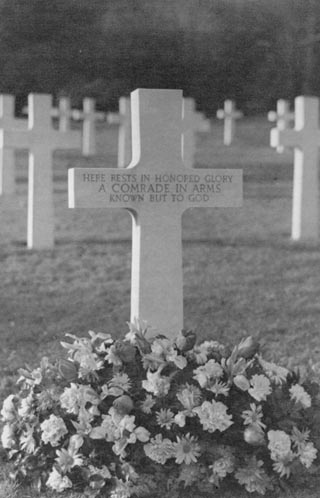


Friday, November 10, 2006
"The legend lives on from the Chippewa on down...
It is also the birthday of the U.S. Marine Corps!