Showing posts with label American History. Show all posts

Monday, January 11, 2010

New Site - The Maine Journey: Experiences in Maine

Original post 1/11/09

For a couple years, I've been working off and on to complete a small side project. Today, I finally finished it up. I utilized the blog format to get it together, but it's not really a blog. Instead, it's more of a conventional web site, with a blog-style Comments section. I've explained why I chose to undertake this piece of history in the Introduction:
This website, The Maine Journey: Experiences in Maine, is a "virtual" reproduction of an actual field trip guide of the same name that was written and published for 7th Grade students from the towns of Etna, Dixmont, Carmel and Levant beginning in 1981. It was based upon the experiences of the students and staff during the 1980 Maine Journey as well as other information. The guide was written by Project Director Suzanne Smith of the Levant Consolidated School and Assistant Project Director Trudy Walo of the Etna-Dixmont school.

I moved to Levant, Maine in 1978 and attended the Levant Consolidated School in 1978/79. At that time, 5th grade students who lived in Levant then went to Caravel Jr. High School (now Caravel Middle School), which took 5th to 8th grade students from Levant and the neighboring town of Carmel (though Carmel had it's own 5th grade, too). Together, Carmel and Levant comprised MSAD (Maine Scholastic Administrative District) #23. The nearby towns of Etna and Dixmont comprised MSAD #38 and also shared a school. Both MSAD's were administered by the same School Superintendent.

Suzanne Smith began teaching at the Levant Consolidated School in September 1963 and was its principal for 30 years. She was not only the prime mover behind the Maine Journey, but also Director of the Levant recreation department. In this role, she did much to help my father obtain uniforms, bats and balls when he coached various youth baseball teams in the town. She cared about all facets of the lives of the kids of Levant and her interest in their lives continued well past the time they spent under her guidance. She was a regular attendee at the 8th grade and High School graduations of her Levant kids. Suzanne Smith passed away in June of 2005 (just a few days before her retirement). Shortly thereafter, I began to try to think of some appropriate way in which I could pay homage to this wonderful lady. That's when serendipity--or a larger force--lent a hand.

Though an engineer, I had always loved history and in 2003 I decided to pursue a Master's Degree in History at Providence College in Rhode Island (the state in which I currently live with my family). Shortly after Suzanne's death--as I was wrapping up my thesis work--I happened to be looking through some history books when I spotted my slightly tattered copy of the Maine Journey Field Trip Guide. Along with a flood of memories came a realization of the nature of the impact that Suzanne had on my life. I realized that her Maine Journey project was one of the significant educational experiences in my life. Further, I believe that the experience of traveling around the state in a school bus to learn about Maine life and history played a part in leading me towards a stint in the Merchant Marine and, eventually, to my going back to school for a history degree. As is so often the case, I never got a chance to thank her. Thus, I offer this small token of appreciation: A "virtual" Maine Journey.

The layout of this site is simple. I have reproduced--in the form of separate posts--the actual text and pictures from the guide as it pertains to a particular place that was visited--or was marked as a potential place to visit--during the Maine Journey. Please note that the original Maine Journey Field Trip Guide was written over 25 years ago and that many of the places visited and described (and prices charged!) back then have changed quite a bit. For instance, the paper industry in Maine has undergone immense change and most (if not all) of the original paper mills and Companies that were visited back in the 1980's have either closed down or have been swallowed up by larger companies. There are many listings with a "*", indicating they were not visited in 1980, which was the year prior to the publication of the guide. However, be assured that students did visit all of these places over the years.

On the right are relevant links to those sites. Some of the places have either undergone name changes or were incorporated into larger museums. Some simply ceased to exist. In general, I've made every effort to provide links to sites that I believe reflect the original places as much as possible. I've also taken the editorial license to remove references to specific people, phone numbers and addresses for points of contact that were originally provided in the Field Trip Guide.

In conclusion, "Thanks" to all of those educators and staff affiliated with the Maine Journey during its years of operation. The impact you had on innumerable students will not be forgotten. So, please feel free to leave a comment about these particular places or anything in general about Maine. Most of all: enjoy and learn.

Sunday, January 10, 2010

John Adams and the Problem of Contemporary Political Classification

Original post 7/12/08

NB: A version of this was first posted at Anchor Rising.


Providence Journal editorialist Ed Achorn had a piece yesterday on John Adams and recommended taking in the HBO mini-series that is now out on DVD (I hope to). Coincidentally, I had been thinking about Adams after listening to the Independence Day show of local radio talk-show host Matt Allen, during which he he read the entire Declaration of Independence and extolled the virtues of our great nation. (Full disclosure--contributors to another website I co-founded, anchorrising.com, have a weekly spot on his show and occasionally are in-studio guests). The conversation was wide-ranging, and along the way he made an off-the-cuff remark along the lines that John Adams was a Democrat and Thomas Jefferson was a Republican.

Wha.....? I thought. I suspected it was based on the fact that Adams was a prominent member of the post-Revolution Federalist Party (along with George Washington and Alexander Hamilton, incidentally), which advocated a strong central government. Given Matt's, shall we say, inclination against big government, I can understand why he'd think that anyone for a strong national government--no matter the time or place, I suppose--was akin to what we would call a contemporary, big government Democrat.

As it turned out, Matt was being a bit anachronistic--though knowingly so--by attributing the Federalist's desire to centralize power as the equivalent of today's conception of "big government." The one-off remark missed the historical context surrounding the rise of the Federalist philosophy of government (hey, it was a talk-show!), which was based on a belief that they urgently needed to strengthen and tighten the internal ties of their nascent nation so it could survive in a belligerent world.

As I discussed with Allen (briefly), Adams is considered by most conservatives to have been the first American conservative; one of their own, much less a Founding era Democrat! He wasn't interested in encroaching on the rights of the population or imposing arbitrary taxes or monetary redistribution or instituting a vast bureaucracy or creating programs to address every ill, whether real or perceived. In fact, neither were his political opponents, Jefferson's Democratic-Republicans. I guess the truth of the matter is that, in the Founding era, there really was no equivalent to the modern conception of a big-government Democrat. They came along with Woodrow Wilson and, later, FDR.

Here's some of that historical context I was talking about.

After the Revolution, it was becoming clear to many of the Founders that the Articles of Confederation simply didn't have enough teeth. The government they provided for was very weak and the particular interests of the various states trumped those of the nation to the detriment of all. European powers played the states off of each other and threatened to economically, or even militarily, divide and conquer the young nation. For example, on economic problem was the inability of the national government to place duties on imports. This was a key economic weapon against great powers like Great Britain who restricted imports from America. In 1781 Congress, under the Articles, asked the states for permission to enact duties, but all such actions required "unanimous consent" and--would you believe it--Rhode Island refused.

As for foreign affairs, with no national army, Great Britain made excuses for not abandoning their forts in the American west; with no navy, the Barbary Pirates attacked American merchant ships and put their crews into slavery; with no consolidated diplomatic "vision", virtually no national treaties could be signed (again, because of a high hurdle of approval) while individual states made their own treaties. The colonies had won independence together, but in their freedom, they were drifting apart as each state viewed itself as a sovereign nation. In reality, they were setting themselves up to be cherries ripe for the picking. The states had become their own worst enemies.

In the debate over the creation of a new government, Alexander Hamilton, James Madison and John Jay wrote the Federalist Papers to explain why the new Constitution, one that described a stronger central government than that of the Articles of Confederation, was required for a young and vulnerable nation. They were opposed by the Anti-Federalists, who argued against the centralization of power put in place by the Constitution. (Eventually, the Anti-federalist inspired Bill of Rights were thrown in as a compromise to get passage of the Constitution).

During this debate, Adams was in Great Britain, and was asked to hastily compile something to help convince the states of the wisdom of passing the new Constitution. His A Defence of the Consitution of Government of the United States of America helped elaborate further on the principles of the balance of power within government and how a more complicated government guided by laws was necessary to maintain the liberty so desired by the American people. (In this, he was informed by his own work as the chief personality involved in the drafting of the Massachusetts Constitution). A selection from Defence--in this case Adams' theory on the importance of property--is probably enough to show why many consider him a conservative:
Suppose a nation, rich and poor, high and low, ten millions in number, all assembled together; not more than one or two millions will have lands, houses, or any personal property; if we take into the account the women and children, or even if we leave them out of the question, a great majority of every nation is wholly destitute of property, except a small quantity of clothes, and a few trifles of other movables...if all were to be decided by a vote of the majority, the eight or nine millions who have no property, would not think of usurping over the rights of the one or two millions who have? Property is surely a right of mankind as really as liberty. Perhaps, at first, prejudice, habit, shame or fear, principle or religion, would restrain the poor from attacking the rich, and the idle from usurping on the industrious; but the time would not be long before courage and enterprise would come, and pretexts be invented by degrees, to countenance the majority in dividing all the property among them, or at least, in sharing it equally with its present possessors. Debts would be abolished first; taxes laid heavy on the rich, and not at all on the others; and at last a downright equal division of every thing be demanded, and voted. What would be the consequence of this? The idle, the vicious, the intemperate, would rush into the utmost extravagance of debauchery, sell and spend all their share, and then demand a new division of those who purchased from them. The moment the idea is admitted into society, that property is not as sacred as the laws of God, and that there is not a force of law and public justice to protect it, anarchy and tyranny commence. If "Thou shalt not covet," and "Thou shalt not steal," were not commandments of Heaven, they must be made inviolable precepts in every society, before it can be civilized or made free.
Sound like a modern day, "big government Democrat" (or "Republican" for that matter!) to you?

But it does get more complicated as we look away from political philosophy and towards actual politics. During Washington's first term as President, two factions emerged with different ideas and priorities as to how the new government should operate. Washington, Adams and Hamilton eventually identified themselves as Federalists, which wanted a strong army and navy, central banking (especially consolidation of state debt into national and the establishment of national credit), strong courts and also favored Great Britain in trade and foreign affairs. Jefferson and Madison would dub themselves Democratic-Republicans and they and their party opposed a strong central government, banking, a standing army--and especially navy--and looked to France for political and philosophical inspiration.

In reality, Washington mostly tried to stay above the partisanship. He was all about noblesse oblige and, as Father of the Country, he could pull it off (though he still came under some criticism for being too "kingly"). Hamilton was the heart-and-soul of the Federalist Party and leader of the so-called High Federalists, who, without pushing it too far, thought that Great Britain had the right idea with an aristocracy and all. For his part, as indicated above, Adams believed in the balance of power, but also in the necessity of a strong central government to facilitate the unification of the disparate colonies and factions when needed. Such was, according to Russell Kirk, Adams' "practical conservatism."

After the nasty election of 1796, Adams, who didn't get along with Hamilton and his allies, was a man very much alone as President. He was left to carve his own path during his single term. But with no allies in either party, he weathered a few crises (XYZ affair and the Quasi-war with France most notably) and served only one-term, losing to the popular Jefferson in the election of 1800 (sometimes dubbed the second revolution).

The legacy of John Adams is hard to encapsulate, and a scattershot blog post can't do him justice. But his writings and political philosophy as well as his determination in the face of personal unpopularity stand out for me. And I've got a soft spot because he managed to keep a foundering U.S. Navy afloat when so many, including Thomas Jefferson--who would later benefit from Adams investment in the Navy against the Barbary Pirates--wanted to sell it off. Adams believed in a strong national defense and strong financial institutions and a central government that could stand up to enemies "foreign and domestic." His idea of a strong national government was meant to deal with these issues, not to encroach into every aspect of Americans' lives.

ADDENDUM: Conservatives have long pointed to John Adams as the first prominent proponent of an American-style conservatism. Russel Kirk and Peter Viereck both wrote histories of American conservatism and each regard Adams as an American conservative touchstone. Many historians--Joseph Ellis, David McCullough and Richard Brookhiser come to mind--regard Adams as essentially conservative, too. They base their classification on Adams' on political thought as expressed in his voluminous writings.

The Encyclopedia Britannica offers a helpful and concise summary of Adams' political thought (the entry was written by Joseph Ellis):
Adams wished to warn his fellow Americans against all revolutionary manifestos that envisioned a fundamental break with the past and a fundamental transformation in human nature or society that supposedly produced a new age. All such utopian expectations were illusions, he believed, driven by what he called “ideology,” the belief that imagined ideals, so real and seductive in theory, were capable of being implemented in the world. The same kind of conflict between different classes that had bedeviled medieval Europe would, albeit in muted forms, also afflict the United States, because the seeds of such competition were planted in human nature itself. Adams blended the psychological insights of New England Puritanism, with its emphasis on the emotional forces throbbing inside all creatures, and the Enlightenment belief that government must contain and control those forces, to construct a political system capable of balancing the ambitions of individuals and competing social classes.

His insistence that elites were unavoidable realities in all societies, however, made him vulnerable to the charge of endorsing aristocratic rule in America, when in fact he was attempting to suggest that the inevitable American elite must be controlled, its ambitions channeled toward public purposes. He also was accused of endorsing monarchical principles because he argued that the chief executive in the American government, like the king in medieval European society, must possess sufficient power to check the ravenous appetites of the propertied classes. Although misunderstood by many of his contemporaries, the realistic perspective Adams proposed—and the skepticism toward utopian schemes he insisted upon—has achieved considerable support in the wake of the failed 20th-century attempts at social transformation in the communist bloc. In Adams’s own day, his political analysis enjoyed the satisfaction of correctly predicting that the French Revolution would lead to the Reign of Terror and eventual despotism by a military dictator.
By the way, Jefferson was decidedly pro-French Revolution, along with the rest of his party, the Democratic-Republicans. Ellis also wrote the EB entry forJefferson, which includes this bit about the Adams and Jefferson retirement correspondence:
The reconciliation between the two patriarchs was arranged by their mutual friend Benjamin Rush, who described them as “the North and South poles of the American Revolution.” That description suggested more than merely geographic symbolism, since Adams and Jefferson effectively, even dramatically, embodied the twin impulses of the revolutionary generation. As the “Sage of Monticello,” Jefferson represented the Revolution as a clean break with the past, the rejection of all European versions of political discipline as feudal vestiges, the ingrained hostility toward all mechanisms of governmental authority that originated in faraway places. As the “Sage of Quincy (Massachusetts),” Adams resembled an American version of Edmund Burke, which meant that he attributed the success of the American Revolution to its linkage with past practices, most especially the tradition of representative government established in the colonial assemblies. He regarded the constitutional settlement of 1787–88 as a shrewd compromise with the political necessities of a nation-state exercising jurisdiction over an extensive, eventually continental, empire, not as a betrayal of the American Revolution but an evolutionary fulfillment of its promise.

These genuine differences of opinion made Adams and Jefferson the odd couple of the American Revolution and were the primary reasons why they had drifted to different sides of the divide during the party wars of the 1790s. The exchange of 158 letters between 1812 and 1826 permitted the two sages to pose as philosopher-kings and create what is arguably the most intellectually impressive correspondence between statesmen in all of American history. Beyond the elegiac tone and almost sculpted serenity of the letters, the correspondence exposed the fundamental contradictions that the American Revolution managed to contain.

Thursday, August 06, 2009

Berkowitz reviews Allitt's The Conservatives: Ideas and Personalities Throughout American History

Peter Berkowitz reviews Patrick Allitt's The Conservatives: Ideas and Personalities Throughout American History in the latest Policy Review. Berkowitz explains that Allitt helps explain the "paradoxes that constitute conservatism in America."
The questions that guide his study are straightforward: “Where did conservatism come from, what are its intellectual sources, and why is it internally divided?” In answering them, however, he is obliged to undertake considerable intellectual legwork because a recognized conservative movement in America only came into existence after 1950. This doesn’t prevent Allitt from reconstructing “a strong, complex, and continuing American conservative tradition” stretching from The Federalist to the Federalist Society. It does mean, though, that to justify his decisions about whom and what to include and exclude in the absence of a formal conservative tradition, a common canon, and an established set of spokesmen, Allitt is compelled to spell out the conflicting elements that distinguish a distinctively conservative approach to politics in America.

Allitt does not seek to go beyond his role as a historian. Yet his learned and fair-minded reconstruction lends support to the view that the proper way forward for conservatives is neither greater purity nor a more perfect unity, but a richer appreciation of the paradoxes of modern conservatism and a more assiduous cultivation of the moderation that is necessary to hold conservatism’s diverse elements, frequently both complementary and conflicting, in proper balance.
I particularly liked Allitt's definition of American Conservatism (as summarized by Berkowitz):
According to Allitt, conservatism is, first, “an attitude to social and political change that looks for support to the ideas, beliefs, and habits of the past and puts more faith in the lessons of history than in the abstractions of political philosophy.” Second, it involves “a suspicion of democracy and equality.” This can be divided into a concern that the formal equality of men before God and law not be confused with equality in all things, particularly virtue, and that too much government power not be placed directly in the people’s hands. Third, conservatism reflects “the view that civilization is fragile and easily disrupted” and therefore it teaches that “the survival of the republic presupposes the virtue of citizens” and calls for “a highly educated elite as guardians of civilization.”

Wednesday, July 22, 2009

Southern Unionists

I guess intuitively I figured there must have been some southerners (even in the "Deep South") who didn't support secession or the Confederate cause. But there were more than I thought and one of them was Mississippi's Newton Knight (h/t):

The recovery of the life of a Mississippi farmer who fought for his country is an important story. The fact that southern Unionists existed, and in very large numbers, is largely unknown to many Americans, who grew up with textbooks that perpetuated the myth of the Confederacy as a heroic Lost Cause, with its romanticized vision of the antebellum South. Some historians have even palpably sympathized with Confederate cavaliers while minimizing—and robbing of credit—the actions of southerners who remained loyal to the Union at desperate cost.

One would never know that the majority of white Southerners had opposed secession, and that many Southern whites fought for the Union. In Tennessee, for example, somewhere around 31,000 white men joined the Union army. In Arkansas more than 8,000 men eventually served in Union regiments. And in Mississippi, Newton Knight and his band of guerillas launched a virtual insurrection against the Confederacy in Jefferson Davis’ own home state.

“There’s lots of ways I’d rather die than being scared to death,” Knight said, and it was a defining statement. At almost every stage of his life this yeoman from the hill country of Jones County, Miss., took courageous stands. The grandson of a slave owner who never owned slaves, he voted against secession, deserted from the Confederate Army into which he was unwillingly impressed, and formed a band called the Jones County Scouts devoted to undermining the Rebel cause locally. Working with runaway slaves and fellow Unionists and Federal soldiers caught behind enemy lines, Knight conducted such an effective running gun battle that at the height of the war he and his allies controlled the entire lower third of the state. This "southern Yankee,” as one Rebel general termed him, remained unconquered until the end of the war. His resistance hampered the Confederate Army’s ability to operate, forced it to conduct a third-front war at home, and eroded its morale and will to fight.

Apparently, the story of Knight is "soon to be a major motion picture."

UPDATE: Apparently, there is a scholarly controversy over the matter.

Thursday, June 18, 2009

Gaspee Day 2009

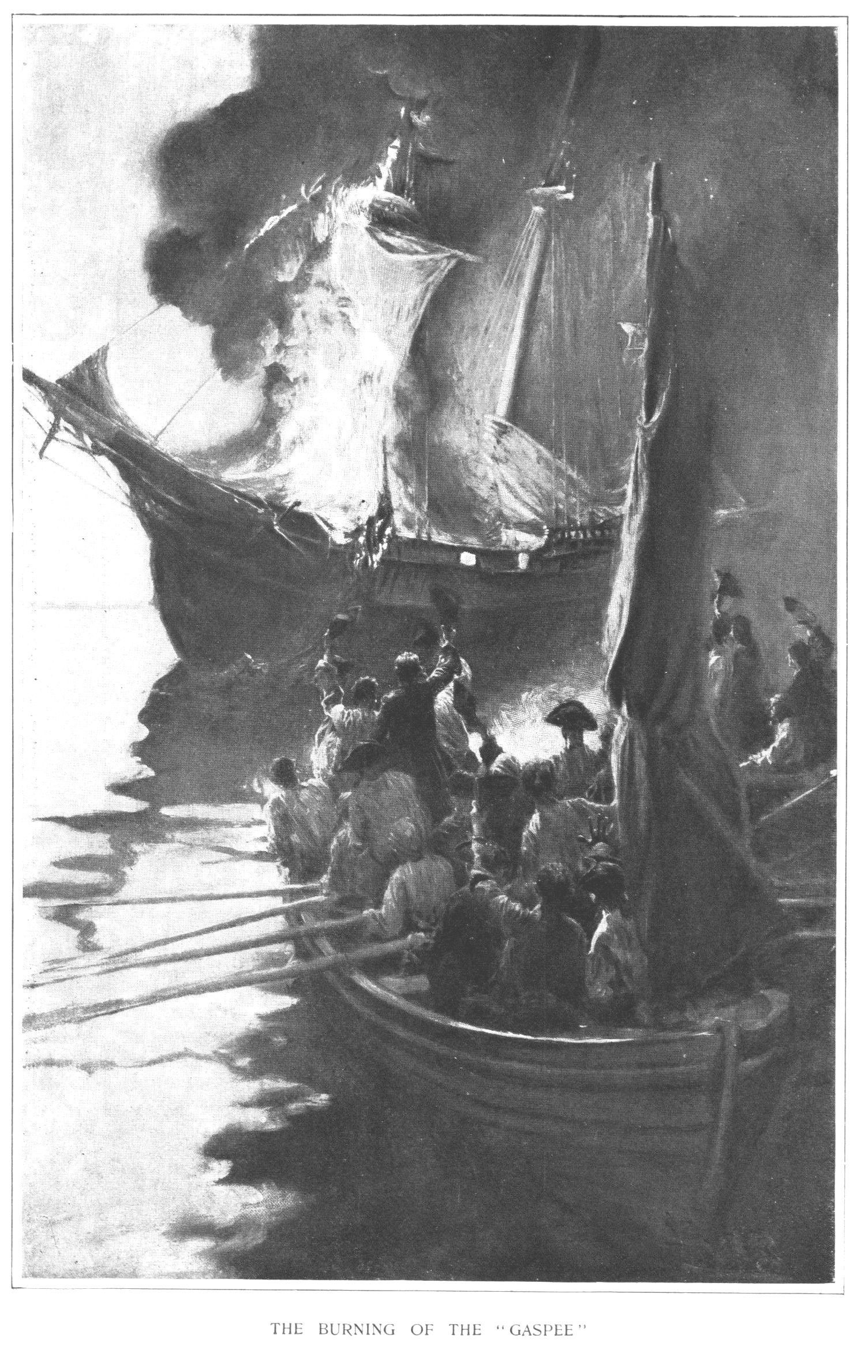
In Warwick and Cranston, Rhode Island, Gaspee Day commemorates the sinking of the HBMS Gaspee by Rhode Islanders in 1772. From Wikipedia:

In early 1772, Lieutenant William Dudingston sailed HBMS Gaspée into Rhode Island’s Narragansett Bay to aid in the enforcement of customs collection and inspection of cargo. Rhode Island had a reputation for smuggling and trading with the enemy during wartime. Dudingston and his officers quickly antagonized powerful merchant interests in the small colony. On June 9, the Gaspée gave chase to the packet boat Hannah, and ran aground in shallow water on the northwestern side of the bay. Her crew were unable to free her immediately, but the rising tide could allow the ship to free herself. A band of Providence members of the Sons of Liberty rowed out to confront the ship's crew before this could happen.[5]

At the break of dawn on June 10, the ship was boarded. The crew put up a feeble resistance and Lieutenant Dudingston was shot and wounded, and the vessel burned to the waterline.
That's the short version, be sure to go to Gaspee.org for MUCH MORE.

And every year, about this time, we still hold the Gaspee Days Parade. Here are some pics (many more to be found at official websites):

The Kentish Guards


Minutemen (including Rehoboth)


Colonial Navy of Massachusetts


Ancient Mariners of Connecticut


The Patuxet Rangers


Friday, March 13, 2009

Life on the Plantation

Rhode Island and Providence Plantations was established by Royal Charter in 1663:
Because titles to these lands rested only on Indian deeds, neighboring colonies began to covet them. To meet this threat, Roger Williams journeyed to England and secured a parliamentary patent in March 1643-44 uniting the four towns into a single colony and confirming his fellow settlers' land claims. This legislative document served adequately as the basic law until the Stuart Restoration of 1660 made it wise to seek a royal charter.

Dr. John Clarke was commissioned to secure a document from the new king, Charles II, that would both be consistent with the religious principles upon which the tiny colony was founded and also safeguard Rhode Island lands from encroachment by speculators and greedy neighbors. He succeeded admirably. The royal charter of 1663 guaranteed complete religious liberty, established a self-governing colony with local autonomy, and strengthened Rhode Island's territorial claims. It was the most liberal charter to be issued by the mother country during the entire colonial era, a fact that enabled it to serve as Rhode Island's basic law until May 1843.

To this day, the official name of the state is still the state of "Rhode Island and Providence Plantations", though the last half of the name has been forgotten by just about everyone for a very long time. Basically, the full name has been relegated to nothing but an interesting piece of trivia: the littlest U.S. state also has the longest name. So no one really thinks much about it. Well, except a few who want to officially drop the "Plantations."

A group of Smith Hill legislators, along with members of the black community, believe it’s time for a name change that does not conjure up images of the slave trade.

“That we still have the word ‘plantation’ in our name is really a grave injustice and an insult to people in our community,” said Sen. Harold M. Metts, D-Providence.

He and other legislators, reviving a decades-old proposal, have introduced companion bills in the House and Senate to place a question on the next election ballot that asks voters whether they want to change the state’s official name to “Rhode Island.”

In years past the proposal has gone nowhere, with critics saying that the state’s name –– however flawed –– is part of the fabric of the Ocean State’s history.

But supporters say otherwise.

“We’re part of history and we’re changing that history and we don’t want to see that name anymore,” said fellow sponsor Rep. Joseph Almeida, D-Providence, at a news conference yesterday.

The proposal is much bigger than a name change, they said. It’s about making the state aware of its ties to slavery and moving forward, free of that burden.

“If we look at history, history is written for us to avoid the past and to move on,” said Dennis Langley, executive director of the Urban League of Rhode Island.

Their history is correct. Newport was a major slave port and Charles Rappleye's Sons of Providence is a fine, recent work that covers both this and the role that the Brown family (founders of Brown University) had in the slave trade. In fact, Brown University has undergone a very public self-examination and has taken various steps to account for the fact that their foundations were built upon slavery. It is also true that some of the farms in the "South County" region of the state did operate with slave labor.

In Narragansett County, conditions favored large-scale farming, and here more than anywhere else in the North a system began to emerge that looked like the Southern plantation colonies. In parts of "South Country" (as Narragansett also was called), one-third of the population was black work force by the mid-18th century. That's comparable to the proportion of slaves in the Old South states in 1820. Narragansett planters used their slaves both as laborers and domestic servants. William Robinson owned an estate that was more than four miles long and two miles wide, and he kept about 40 slaves there. Robert Hazard of South Kingstown owned 12,000 acres and had 24 slave women just to work in his dairy. The Stantons of Narragansett, who were among the province's leading landowners, had at least 40 slaves.

In keeping with the usual pattern, a higher percentage of blacks meant a more strict control mechanism. South Kingstown had perhaps the harshest local slave control laws in New England. After 1718, for instance, if any black slave was caught in the cottage of a free black person, both were whipped. After 1750, anyone who sold so much as a cup of hard cider to a black slave faced a crushing fine of £30.


But the point is that the "Plantations" referred to in the original charter was a common appellation for "a new settlement or colony". Obviously, the meaning of the word became associated with chattel slavery in the South and carries a negative connotation today. I completely understand that. But by pushing to remove "Providence Plantations" from the official name, by "changing that history", proponents are being anachronistic in their application of the term.

They are also being impractical in these times. Like other states, Rhode Island is facing some serious fiscal difficulties--there are plenty of things that our politicians should be worried about besides a feel-good measure of limited appeal and utility. In addition, there are costs incurred by such a change (there are many plaques, stationary, etc. that contain the full name, which would have to be changed).

One attractive argument for dropping the name is because it is so little-used and unknown. So what's the big deal, right? Well, there is the argument that this would be just the tip of the iceberg (ah yes, the "slippery slope." I know, I know...)

But allow me to indulge...What about the City of Providence. I think many people would associate the word "Providence" with religion and one of the definitions of "Providence" is "A manifestation of the care and superintendence which God exercises over his creatures; an event ordained by divine direction." The City of Providence is an official government entity. Should a government have a name that is so overtly religious? Or is that a history that needs to be changed, too?

Sunday, March 01, 2009

Review - Defying Empire:Trading with the Enemy in Colonial New York

Thomas M. Truxes - Defying Empire:Trading with the Enemy in Colonial New York

Everyone in colonial New York City traded with the enemy (the French) during the Seven Years' War (what we colonial descendants refer to as the French and Indian War). OK, that's an overstatement, but as Thomas Truxes fine work explains, it comes close to the truth. The City's merchants (obviously) and politicians (surprised?) were up to their necks in illegal trade before, during and after this period. "[T]rade with the enemy...did not flow from disloyalty to the Crown or indifference to the fate of the nation," writes Truxes, "...rather, the naked manifestation of a powerful commercial impulse synonymous with the great metropolis."

And while other colonies traded with the enemy--Connecticut and Rhode Island, for instance, were notorious for their "independence" in these matters--New York had distinct advantages when it came to "laundering" illegal goods. Its deep harbor and relatively small size made it easy for large ships to load and unload quickly and it had established itself since its days as a Dutch colony, as a key transshipment port.

During the war, New York's advantages as a supply depot for the British Royal Navy lent to its importance in colonial commerce and wartime machinations. This also made it an attractive target to the French, which, in turn, caused the British to increase the naval presence further. In addition, privateers from New York struck out to capture French prizes.

But there was money to be made by trading with the enemy, too. New York was both hub and spoke of illicit trade that went between Europe, the Caribbean islands and the colonies. Already established smuggling operations easily accommodated further illicit trade with the French. War or no war, they were well practiced at avoiding the authorities.

It certainly didn't help that many local politicians and crown representatives were in on the network. And, as others have argued, by the time the Crown, or Parliament, tried to do something, it was already too late. The horse was well out of the barn: these were the unfortunate rewards of so-called salutary neglect. As Truxes writes:
The flour act of 1757 was the sole piece of parliamentary legislation directed at Briton trading with the enemy during the Seven Years' War. If it was to be effective, the law would require broad support on both sides of the Atlantic. But the restrictions and penalties contained in the act applied only to colonial America. Cargoes dispatched from Great Britain and Ireland were unaffected. The discriminatory character of the act was immediately apparent. The ill-conceived legislation was one of the great blunders of the eighteenth-century British Parliament. Before a decade had passed, there would be others. (p.68)
Truxes has conducted extensive research and it shows. He has a feel for the city at that time and also does a fine job explaining the relationships between various politicians and merchants. Indeed, through his explanation of both the geography and the personalities involved, he brings 1760's New York to life. He also provides a very good overview of the Caribean trade ports and, in general, this is a fine piecet of economic history. Further, it contributes to the historiography that supports the contention that it was Britain's reaction (or overreaction) to the conduct of its American colonists during the Seven Years' War that ultimately set the stage for the Revolution.

Monday, February 16, 2009

Rating the Presidents

CSPAN has another Presidential rating survey out. I don't have time for an extended "review" (well, frankly, my general response is "whatev"). But the two things I noticed were also noticed by KC Johnson at Cliopatria (thanks Ralph and sorry KC for initially giving the wrong attribution...sloppy of me). Why the hell does JFK rate so high, and why is Bill Clinton moving UP in these things? As KC points out:
Perhaps the most dubious rankings, however, involved the overall scores given to two recent Democrats, John Kennedy and Bill Clinton. Kennedy was ranked the sixth-best President, up from eighth in 2000. The two Presidents he surpassed between 2000 and 2009: Thomas Jefferson and Woodrow Wilson. In 2000, eighth seemed like a pretty high ranking for Kennedy, but it’s hard to justify placing him over two two-term chief executives with major accomplishments in both the foreign policy and domestic spheres.
KC digs in a bit more and has some other questions, so check it out. Regardless, these things are obviously subjective. Though, the top two continue to be Lincoln and Washington. At least most can agree on that!

Monday, December 29, 2008

Medieval Scottish "Rap"

According to Professor Ferenc Szasz, contemporary "rap battles" (which I thought originated from "the dozens") "derive from the ancient Caledonian art of 'flyting'."

According to the theory, Scottish slave owners took the tradition with them to the United States, where it was adopted and developed by slaves, emerging many years later as rap.

Professor Szasz is convinced there is a clear link between this tradition for settling scores in Scotland and rap battles, which were famously portrayed in Eminem's 2002 movie 8 Mile.

He said: "The Scots have a lengthy tradition of flyting - intense verbal jousting, often laced with vulgarity, that is similar to the dozens that one finds among contemporary inner-city African-American youth.

"Both cultures accord high marks to satire. The skilled use of satire takes this verbal jousting to its ultimate level - one step short of a fist fight."

The academic, who specialises in American and Scottish culture at the University of New Mexico, made the link in a new study examining the historical context of Robert Burn's work.

The most famous surviving example of flyting comes from a 16th-century piece in which two rival poets hurl increasingly obscene rhyming insults at one another before the Court of King James IV.

Titled the Flyting Of Dunbar And Kennedy, it has been described by academics as "just over 500 lines of filth".

Professor Szasz cites an American civil war poem, printed in the New York Vanity Fair magazine on November 9, 1861, as the first recorded example of the battles being used in the United States.

Wednesday, October 29, 2008

Review: Lincoln's Admirals

Craig L. Symonds, Lincoln and his Admirals

Weeks into his presidency, Abraham Lincoln was confronted with his first naval question: What to do about Fort Sumter? First, should he re-supply it--and risk war--or not and concede defeat, thereby giving the secessionist South a valuable bit of propaganda? Was there a diplomatic solution? To help answer these questions, he turned to men, most of whom he barely knew, with military, naval and diplomatic expertise. He looked for conventional and unconventional solutions and, in the end, as he did so often, ultimately made the decision himself. An expedition was organized to help the fort. But his lack of experience, the disorganization of his nascent administration and deliberate nature doomed the expedition. Lincoln blamed himself, but learned from the experience. Lincoln's Vice-President Hannibal Hamlin agreed. Writes Symonds:
Hamlin argued that there were two Lincolns: the one who came from Illinois, inexperienced in wielding great power," and the one who emerged later as "the conqueror of a gigantice civil war, the emancipator of slaves, master of the political situation, and savior of the nation."
Lincoln improved upon his performance in matters naval by taking some those matters into his own hands. In the west, he championed a river campaign utilizing combined army and naval forces that could strike simultaneously at separate targets and force the South to split its military resources. While not as directly involved, he was similarly heartened by the success of Admiral David Farragut's taking of New Orleans and run up the Mississippi. These combined operations were part of the "Anaconda Plan" and succeeded in giving the North a toehold on both ends of the Mississippi as it ran through the South.

The other significant part of the Anaconda plan was the blockade of southern ports. Here, Lincoln first had to navigate admiralty law while his fleet was built or acquired. Thanks to "King Cotton," European nations had a vested interest in maintaining trade with the South. They would not submit to a "paper blockade": the North would have to have a real force in place. Yet, the logistics of putting a blockade in place seemed to worry Lincoln less than the legal gymnastics required to legitimize a blockade against the South, which Lincoln had contended was not an entity in and of itself. Symond's explains this well.

One of the best stories told by Symonds is that of Lincoln's visit to the Hampton Roads region of Virginia while the Merrimack and Monitor circled each other warily amidst the Union blockade. Lincoln's personal intervention and suggestions prompted both the taking of a key shore positions as well as, ultimately, the scuttling of the infamous Confederate ironclad.

Symond's also covers the role that "contraband" (freed slaves) played in the Navy and how, traditionally, the maritime service was more accustomed to having blacks among its ranks.
Absorbing the contrabands into the blockade fleet caused scarcely a ripple either among the public at large or within the navy. Historically, free blacks had made up some 15 percent of the navy's enlisted force. During the 1850s, the figure dropped to only about 5 percent; now it would grow again back up to 15 percent. Naval officers, always eager for more hands, generally welcomed the contrabands on board as simply so many more strong backs, and the white sailors welcomed them, too, mainly because the newcomers were generally assigned "the dirtiest, most strenuous, and most physically demanding jobs," thereby relieving white sailors of those duties....White officers and men alike took a certain delight in using the enemy's slaves against them.
Interestingly, according to Symonds, Lincoln's early success on the rivers of the West and in implementing the blockade
...may have encourage Lincoln to take a slightly harder line with McClellan, who was still stalled on the Virginia peninsula battling the mud and his own fears. Union forces were successful elsewhere, so why not in Virginia?
Elsewhere in the book, Symond's describes the political management Lincoln had to engage in to sooth fragile egos and get the right men in the right places as he deemed necessary. His support of the ordnance expert John A. Dahlgren often put him at odds with the navy establishment, but he believed in Dahlgren and promoted him to admiral even though he lacked seagoing experience. At higher levels, he constantly had to manage the relationship (or lack thereof) and differing agendas of Secretary of the Navy Gideon Welles and Secretary of State William Seward.

Symonds covers other matters, such as the Trent affair and the hunt for the Confederate blockade runners (both involving the combustible Admiral Charles Wilkes, incidentally) as well as the messy aftermath of the "easing out" of Admiral Samuel Du Pont and the French invasion of Mexico.

Symonds has done a fine job of narrative history. While the focus is on the navy, he doesn't leave out the better known historical touchstones, which help to provide context for Civil War afficianados who may not be as familiar with naval timelines. The work is well-sourced and a valuable contribution to the existing Civil War literature. Symond's is to be commended.

Monday, September 29, 2008

So You Think You Remember the Fifties?

George and Robert Leonard, founding members of the Fifties retro group Sha Na Na, examine the scholarly interest in how their singing group helped change the way Americans remembered the decade of the 1950's.

In the last few years, an unlikely group of scholars has been studying Columbia’s Sha Na Na as a test case: meta-historians, theoreticians of cultural history itself. In 2004, Rutgers University Press published a bold new book by Goucher professor Daniel Marcus, Happy Days and Wonder Years: The Fifties and Sixties in Contemporary Cultural Politics. In 2006, Elizabeth E. Guffey, a Stanford Ph.D. and associate professor at SUNY Purchase, published Retro: The Culture of Revival (London and Chicago: Reaktion Books distributed by the University of Chicago Press, retrothebook.com). Both books contain extensive studies of Sha Na Na’s “Fabricated Fifties” (Guffey’s term) because Marcus and Guffey — working quite independently — discovered Sha Na Na and Columbia College, in 1969, playing an unusual role in 20th century American history.

More precisely, in inventing it.

Read the whole thing for an interesting case study on the differences between history and preferred memory.

The Civil War in Four Minutes

Sunday, September 28, 2008

Review: Failures of the Presidents

Thomas J. Craughwell (with M. William Phelps), Failures of the Presidents: From the Whiskey Rebellion and War of 1812 to the Bay of Pis and War in Iraq.

Every president has his failures and successes (well, maybe not Andrew Johnson) and Thomas J. Craughwell has presented some interesting Presidential decisions in the interest of showing the former. He starts out explaining how Washington's reaction to the Whiskey Rebellion and Adams' acceptance of the Alien and Sedition Acts were major contributing factors to the fall of the Federalists and the rise of Jefferson's Democratic-Republicans. Jefferson also comes under criticism (the Embargo Act) as do many others up through George W. Bush (Iraq). Interestingly, Presidents Nixon (the bombing of Cambodia and Watergate) and Carter (Iran hostages and Energy Crisis/"Malaise") earn the dubious distinction of having two major failures addressed by Craughwell.

Craughwell does a good job of laying the historical context for the layman on the way to explaining why each of his examples were, indeed, failure. However, sometimes he pushes too hard in one direction. Did the Whiskey tax, the impetus for the Rebellion, and the Alien and Sedition Acts contribute to the end of the Federalist Party? Yes. But so did the propaganda and hysteria fomented by Jefferson and his D/Rs. Craughwell does mention this, but the emphasis is clearly on the actions of the then-current Presidents (Washington and Adams), not on the actions of the one who sought that office (Jefferson) and his supporters.

However, in other instances he's spot on, such as when he takes Andrew Jackson to task for the Trail of Tears, FDR for the Japanese internment and Jimmy Carter for the Iranian hostage crisis. He also presents a few obscure decisions as historical turning points, thus enabling a new perspective on an old issue. One such example is his account of President Grant's attempt to annex Santo Domingo. Grant's idea was to relieve the pressure between newly freed slaves and whites in the newly-conquered South by allowing the emigration of freed blacks to Santo Domingo. Craughwell's explanation--that this sent the signal that Grant himself believed that there would never be a reconciliation between the races in the South--is intriguing and warrants deeper analysis.

Craughwell begins his book explaining that "weighing the successes and failures of a presidency takes time." Nonetheless, he still attempts to analyze the "failure" of more contemporary events such as those by Nixon, Carter, Iran-Contra and the War in Iraq. (He also explains in the Forward that he, his co-author and editors couldn't agree as to whether the Clinton sex scandals did serious harm to the nation).

There are no citations or bibliography, but a review of the "Suggested Reading" list offers clues as to Craughwell's source material and may help explain the tone and nature of his conclusions for a couple of these later chapters. For instance, the reading list he suggests for the topic of George W. Bush and Iraq consists of these 9 items:

Paul Berman's, Terror and Liberalism
Rajiv Chandrasekaran's, Imperial Life in the Emerald City
Andrew Cockbrun's, Rumsfeld: His Rise, Fall, and Catastrophic Legacy
Karen DeYoung's, Soldier: The Life of Colin Powell
Robert W. Drapers, Dead Certain
David Hare's anti-war play, Stuff Happens
Michael Isikoff and David Corn's, Hubris: The Inside Story of Spin, Scandal and Selling of the Iraq War
Bob Woodward's, State of Denial
Valerie Plame Wilson's, Fair Game

An informed reader will recognize that this is not exactly a reading list where one would find an unbiased--much less a sympathetic--account of the Iraq War. Perhaps Craughwell should have followed his own advice, resisted temptation and left more for a sequel?

In fact, a sequel would be welcome. Setting aside the more contemporary accounts, Craughwell offers an interesting presentation and analysis of many events. There are many more that are deserving analysis. Would he be so bold as to argue that dropping the Bomb on Hiroshima was a failure? Or what about the War with Mexico?

Obviously, there is room to argue over every "failure" presented, and that's what is so fun about the book. It would be a great conversation-starter in history courses for older high school or undergraduate students and, for the non-scholar, it makes for thoughtful and entertaining reading.

Thursday, September 11, 2008

A People's Documentary

Matt Damon is adapting Howard Zinn's "A People's History of the United States” into a documentary. That's just great. Way to puncture that stereotypical, Hollywood=leftist-America-haters balloon, Matt. Historians are split on the work, but every undergrad history wannabe goes through their own love affair with Zinn's "classic" work. I guess Mr. Damon is still channeling "Good Will Hunting" himself.

Thursday, August 28, 2008

Gaddis Looks at the Bush "Doctrine"

Ralph Luker called attention to Ending Tyranny: The Past and Future of an Idea by John Lewis Gaddis, and (after dissing Victor Davis Hansen) offered that this "may be the first attempt at a positive reappraisal of the Bush administration's legacy in foreign policy." And Ralph followed that up with, "Can you say the Stanford/Yale [Hansen/Gaddis] axis of hackery?"

Anyway, while I know I'm not a bona fide academic historian, I read the piece and I don't see the "hackery."

Gaddis' central goal is to analyze whether there really is a "Bush Doctrine" and whether or not, if it does exist, it will be a flash in the pan or long-lasting; perhaps picked-up by succeeding generations (if not immediately). He surveys the successes and failures of other presidential "doctrines" in an attempt to place Bush's in context. Here's an (extended) example of the sort of analysis Gaddis is trying to provide:
The end of the Cold War left the United States in a position of dominance unrivaled since the days of the Roman Empire. Maintaining humility under such circumstances would have demanded the self-discipline of a saint—and the Americans, like the Romans, have never been particularly saintly. So all at once their efforts to encourage democracy, which had come across during the Cold War as constraining the power of dictators, now looked like an effort to concentrate power in their own hands.

***

And after... September 11, 2001, a wounded nation that was still the most powerful nation began insisting that its future security required the expansion of democracy everywhere. No wonder this frightened people elsewhere, even those also frightened by terrorism.

President Bush reflected this “one size fits all” mentality when he called for “the growth of democratic movements and institutions in every nation and culture.” That sounded like knowing what was best for the world. But then he added: “with the ultimate goal of ending tyranny in our world.” That sounded like liberating people so that they could decide what was best for them; it was language of which the Founding Fathers, John Quincy Adams, Abraham Lincoln and Isaiah Berlin might have approved. So the President managed to compress, into a single sentence, the concepts of both positive and negative liberty.

This may have been a triumph for succinct speech writing, but it was not one for philosophical coherence. Promoting democracy, for the reasons I’ve mentioned, offers no guarantee of ending tyranny, just as ending tyranny offers no guarantee that the newly liberated will choose democracy. Telling people simultaneously that we know best and that they know best is likely to confuse them as well as us. But what if we were to read the President’s sentence as a political rather than a philosophical statement, as a way of respecting the recent past while shifting priorities for the future? A presidential speech, after all, cannot simply dismiss what has gone before, even as it suggests where we should now be going.

If the Bush Doctrine was meant in that sense—if ending tyranny is now to be the objective of the United States in world affairs—then this would amount to a course correction away from the 20th-century idea of promoting democracy as a solution for all the world’s problems, and back toward an older concept of seeking to liberate people so they can solve their own problems. It could be a navigational beacon for the future that reflects more accurately where we started and who we’ve been.

He continues on and asks many questions. He concludes by leaving options open:
President Bush may have proclaimed a doctrine for the 21st century comparable to the Monroe Doctrine in the 19th and early 20th centuries, and to the Truman Doctrine during the Cold War. Only historians not yet born will be able to say for sure. Even that possibility, however, should earn Bush’s memorable sentence greater scrutiny than it has so far received. For it raises an issue that future administrations—whether those of Obama, McCain or their successors—are going to have to resolve: If the goal of the United States is to be “ending tyranny in our world”, then is encouraging “the growth of democratic movements and institutions in every nation and culture” the best way to go about it?

Thursday, August 07, 2008

Going to School on the Barbary Wars

I've done a few substantive posts about the Barbary Wars in the past. Michael Medved is the latest (here's another) to use them to buttress his particular position in contemporary arguments about the War in Iraq and the GWOT. Here are his 7 points.
1. The U.S. often goes to war when it is not directly attacked. One of the dumbest lines about the Iraq War claims that “this was the first time we ever attacked a nation that hadn’t attacked us.” Obviously, Barbary raids against private shipping hardly constituted a direct invasion of the American homeland, but founding fathers Jefferson and Madison nonetheless felt the need to strike back. Of more than 140 conflicts in which American troops have fought on foreign soil, only one (World War II, obviously) represented a response to an unambiguous attack on America itself. Iraq and Afghanistan are part of a long-standing tradition of fighting for U.S. interests, and not just to defend the homeland.

2. Most conflicts unfold without a Declaration of War. Jefferson informed Congress of his determination to hit back against the North African sponsors of terrorism (piracy), but during four years of fighting never sought a declaration of war. In fact, only five times in American history did Congress actually declare war – the War of 1812, the Mexican War, The Spanish American War, World War I and World War II. None of the 135 other struggles in which U.S. troops fought in the far corners of the earth saw Congress formally declare war—and these undeclared conflicts (including Korea, Vietnam, the First Gulf War, and many more) involved a total of millions of troops and more than a hundred thousand total battlefield deaths.

3. Islamic enmity toward the US is rooted in the Muslim religion, not recent American policy. In 1786, America’s Ambassador to France, Thomas Jefferson, joined our Ambassador in London, John Adams, to negotiate with the Ambassador from Tripoli, Sidi Haji Abdrahaman. The Americans asked their counterpart why the North African nations made war against the United States, a power “who had done them no injury", and according the report filed by Jefferson and Adams the Tripolitan diplomat replied: “It was written in their Koran, that all nations which had not acknowledged the Prophet were sinners, whom it was the right and duty of the faithful to plunder and enslave; and that every mussulman who was slain in this warfare was sure to go to paradise.”

4. Cruel Treatment of enemies by Muslim extremists is a long-standing tradition. In 1793, Algerian pirates captured the merchant brig Polly and paraded the enslaved crewmen through jeering crowds in the streets of Algiers. Dey Hassan Pasha, the local ruler, bellowed triumphantly: “Now I have got you, you Christian dogs, you shall eat stones.” American slaves indeed spent their years of captivity breaking rocks. According to Max Boot in his fine book The Savage Wars of Peace: “A slave who spoke disrespectfully to a Muslim could be roasted alive, crucified, or impaled (a stake was driven through the arms until it came out at the back of the neck). A special agony was reserved for a slave who killed a Muslim – he would be cast over the city walls and left to dangle on giant iron hooks for days before expiring of his wounds.”

5. There’s nothing new in far-flung American wars to defend U.S. economic interests. Every war in American history involved an economic motivation – at least in part, and nearly all of our great leaders saw nothing disgraceful in going to battle to defend the commercial vitality of the country. Jefferson and Madison felt no shame in mobilizing – and sacrificing – ships and ground forces to protect the integrity of commercial shipping interests in the distant Mediterranean.

Fortunately for them, they never had to contend with demonstrators who shouted “No blood for shipping!”

6. Even leaders who have worried about the growth of the U.S. military establishment came to see the necessity of robust and formidable armed forces. Jefferson and Madison both wanted to shrink and restrain the standing army and initially opposed the determination by President Adams to build an expensive new American Navy. When Jefferson succeeded Adams as president, however, he quickly and gratefully used the ships his predecessor built. The Barbary Wars taught the nation that there is no real substitute for military power, and professional forces that stand ready for anything.

7. America has always played “the cop of the world.” In part, Jefferson and Madison justified the sacrifices of the Barbary Wars as a defense of civilization, not just the protection of U.S. interests – and the European powers granted new respect to the upstart nation that finally tamed the North African pirates. Jefferson and Madison may not have fought for a New World Order but they most certainly sought a more orderly world. Many American conflicts over the last 200 years have involved an effort to enfort to enforce international rules and norms as much as to advance national interests. Wide-ranging and occasionally bloody expeditions throughout Central America, China, the Philippines, Africa and even Russia after the Revolution used American forces to prevent internal and international chaos.

Tuesday, August 05, 2008

Plimouth Plantation Vandalized

This is just too bad.
Plymouth police say vandals broke into Plimoth Plantation, damaged eight houses, smashed fence sections and stole furs and other items from the replica Pilgrim village.

Police say the living history museum's property manager discovered the damage when she arrived early Saturday morning. A security guard was on duty overnight, but did not report any disturbances.

Police say one or more vandals broke the locks on the houses, smashed crockery and left hatchet marks on the inside walls. They uprooted plants, stole reproduction armor, several beaver and otter furs, and other household items.

Plantation officials gave no damage estimate and are conducting visitor tours as usual. Police say staff cleaning up after the vandalism may have destroyed evidence.

Sunday, August 03, 2008

Review: The Road to Monticello

Kevin J. Hayes, The Road to Monticello: The Life and Mind of Thomas Jefferson.

This book could easily have been titled, "Jefferson the Bibliophile," but the author's inspiration for the actual title was to pay homage to John Livingston Lowe's study of Samuel Taylor Coleridge, The Road to Xanadu. Hayes' literary and intellectual biography uses the books Jefferson loved--as well as those read or possessed by the people taught, met or impacted Jefferson--to chart the intellectual provenance of the Sage of Monticello.

Unsurprisingly, the list of books cataloged by Hayes is immense and impressive. But the insight that Hayes derives from his study of the Sage's reading list (as well as those Jefferson compiled for others), particularly the marginalia found in the books themselves, are the key that unlocks the door to the Jeffersonian mind.

Hayes consistently points out that "Jefferson preferred the life of the mind" and one would have to agree: how else could on man read and write so copiously if he didn't prize intellectual pursuits over most else? The importance of Bacon, Locke and Newton to Jefferson are unsurprising. But Jefferson was also particularly keen for Aesop's fables
...especially those that were useful as political allegories, like the one about the miller, his son, and their ass. By trying to please everyone, the miller ends up pleasing no one and loses his ass in the bargain.
It wasn't always the serious, or at least the factual, book that piqued the Jeffersonian mind
Fiction, Jefferson observed, could fulfill the purpose of teaching moral virtue better than fact. History was too uneven--few episodes in history could excite the "sympathetic emotion of virtue" at its highest level. Fiction, alternatively, could evoke a reader's sympathy because imaginary characters can be fashioned in a way real personages cannot. Fictional characters can illustrate and exemplify "every moral rule of life. Thus a lively and lasting sense of filial duty...is more effectually impressed on the mind of a son or daughter by reading King Lear, than by all the ry volumes of ethics and divinity that ever were written."
Thus did emotion, or a good yarn, help the mind see its way to logic.

For the intellectual historian, the meat-and-potato portions of the book are those in which Hayes traces the literary and philosophical influences of acute Jeffersonian works. Name a piece of writing produced by Jefferson and Hayes will trace its intellectual and literary genealogy. But he does so within the context of the times in which Jefferson was writing and illustrates how Jefferson did more than simply collate and regurgitate information. Jefferson's writing is filled with wisdom gained from reading, but also from his ability to observe and reason.

Jefferson was more than just a man of books, he was also, indelibly, a man--perhaps the man--of his time. Hayes puts Jefferson within historical and intellectual context and illustrates how this impressive thinker was able to build upon past literary works to help create a new and hopefully better nation. There is much here for the scholar and the layperson to digest. Road to Monticello is an important addition to anyone's, even Jefferson's, library.

Thursday, July 31, 2008

Colonial America, or America's Medieval Period

Trevor Burnard, in a piece on the importance of geography over time for historians of Colonial America explains why this is so:
Why are early Americanists so obsessed with region—with geography, in short—rather than with chronology? Why is early America generally organized by space rather than time, at least until the Revolution comes along? In part, of course, the reason for such fixation upon space is because the colonial period is the very important prologue to the main event, which is the formation of the nation state and of United States history proper. The colonial period is thus the medieval section of American history.
Interesting. And it might explain why, as an Americanist, I'm mostly attracted to the Colonial and Revolutionary eras in addition to my "minor" of early Medieval History. Must be that beginnings/transitions appeal to me.

Friday, June 20, 2008

The Baby-Mama Witches of Gloucester

The first thing I thought of when I read the story about the 17 wanna-be baby mamas of Gloucester, Massachusetts were the teenage girls who lay at the center of the Salem Witch Trials. No doubt, this was probably because of the proximity of Gloucester to Salem Village (now Danvers, Mass.). Now, I'm simply not well-versed enough in group psychology or the deeper history of the Salem Witch hysteria to draw any conclusions. I just found these parallels interesting (if they are indeed parallel!).

A little digging brought up some statistical similarities: there were 16 girls in Salem Village who claimed they were the victims of witchcraft, and most were teenagers; there are 17 new baby mama teenagers in Gloucester. Maybe both groups of girls were depressed by their surroundings, or at least picked up on the depression from their parents and community.

Paul Boyer and Stephen Nissenbaum theorized in Salem Possessed: The Social Origins of Witchcraft that the Salem Village witchcraft accusations were a sort of psychological projection that exposed tensions between the agrarian and economically poor Salem Village and its more economically successful neighbor Salem Town. As Philip Greven, Jr. wrote in his review of Salem Possessed (Reviews in American History, Vol.2, No.4, 1974; p.516):
Throughout their book, the underlying assumption which shapes their analysis of the Village and its inhabitants is that this community reflects a particular transitional point in a long-term historical process which was transforming precapitalist agrarian society into more urban, commercial, and capitalistic society. As they observe of [Reverend Samuel] Parriss and the Village, "All the elements of their respective histories were deeply rooted in the social realities of late seventeenth century western culture--a culture in which a subsistence, peasant-based economy was being subverted by mercantile capitalism" (p. 178).
The Time piece on the Gloucester 17 noted:
The past decade has been difficult for this mostly white, mostly blue-collar city (pop. 30,000). In Gloucester, perched on scenic Cape Ann, the economy has always depended on a strong fishing industry. But in recent years, such jobs have all but disappeared overseas, and with them much of the community's wherewithal. "Families are broken," says school superintendent Christopher Farmer. "Many of our young people are growing up directionless."

***
Amanda Ireland, who graduated from Gloucester High on June 8, thinks she knows why these girls wanted to get pregnant. Ireland, 18, gave birth her freshman year and says some of her now pregnant schoolmates regularly approached her in the hall, remarking how lucky she was to have a baby. "They're so excited to finally have someone to love them unconditionally," Ireland says.
Also, its apparent that both groups of teenage girls may have coordinated their actions. Although many believe that the Salem accusers were victims of mass hysteria, perhaps even chemically induced, there is also evidence that they were just "hav[ing] some sport."

Daniel Elliott: Deposition for Elizabeth Proctor

the testimony of Daniel elet aged 27 years or thear abouts who testifieth & saith that I being at the hous of leutennant ingasone one the 28 of march in the year 1692 thear being preasent one of the aflicted persons which cryed out and said thears goody procter William raiment juner being theare present told the garle he beleved she lyed for he saw nothing then goody ingerson told the garl she told aly for thear was nothing: then the garl said that she did it for sport they must have some sport

( Essex County Archives, Salem -- Witchcraft Vol. 1 Page 27 )

The Gloucester baby mamas consciously decided to get pregnant and raise their kids together.
By May, several students had returned multiple times to get pregnancy tests, and on hearing the results, "some girls seemed more upset when they weren't pregnant than when they were," [school principal Joseph] Sullivan says. All it took was a few simple questions before nearly half the expecting students, none older than 16, confessed to making a pact to get pregnant and raise their babies together.
And once each group embarked on their respective escapades, they knew that adults were in place to provide, shall we say, support. In the case of the Salem girls, society was predisposed to attribute their actions to supernatural causes:
At the time, however, there was another theory to explain the girls' symptoms. Cotton Mather had recently published a popular book, "Memorable Providences," describing the suspected witchcraft of an Irish washerwoman in Boston, and Betty [Parriss]'s behavior in some ways mirrored that of the afflicted person described in Mather's widely read and discussed book. It was easy to believe in 1692 in Salem, with an Indian war raging less than seventy miles away (and many refugees from the war in the area) that the devil was close at hand. Sudden and violent death occupied minds.

Talk of witchcraft increased when other playmates of Betty, including eleven-year-old Ann Putnam, seventeen-year-old Mercy Lewis, and Mary Walcott, began to exhibit similar unusual behavior. When his own nostrums failed to effect a cure, William Griggs, a doctor called to examine the girls, suggested that the girls' problems might have a supernatural origin. The widespread belief that witches targeted children made the doctor's diagnosis seem increasing likely.

***
Meanwhile, the number of girls afflicted continued to grow, rising to seven with the addition of Ann Putnam, Elizabeth Hubbard, Susannah Sheldon, and Mary Warren. According to historian Peter Hoffer, the girls "turned themselves from a circle of friends into a gang of juvenile delinquents." ( Many people of the period complained that young people lacked the piety and sense of purpose of the founders' generation.) The girls contorted into grotesque poses, fell down into frozen postures, and complained of biting and pinching sensations. In a village where everyone believed that the devil was real, close at hand, and acted in the real world, the suspected affliction of the girls became an obsession.
The Gloucester girls are surrounded by a support system of a different kind.
The high school has done perhaps too good a job of embracing young mothers. Sex-ed classes end freshman year at Gloucester, where teen parents are encouraged to take their children to a free on-site day-care center. Strollers mingle seamlessly in school hallways among cheerleaders and junior ROTC. "We're proud to help the mothers stay in school," says Sue Todd, CEO of Pathways for Children, which runs the day-care center.

But by May, after nurse practitioner Kim Daly had administered some 150 pregnancy tests at Gloucester High's student clinic, she and the clinic's medical director, Dr. Brian Orr, a local pediatrician, began to advocate prescribing contraceptives regardless of parental consent, a practice at about 15 public high schools in Massachusetts. Currently Gloucester teens must travel about 20 miles (30 km) to reach the nearest women's health clinic; younger girls have to get a ride or take the train and walk. But the notion of a school handing out birth control pills has met with hostility. Says Mayor Carolyn Kirk: "Dr. Orr and Ms. Daly have no right to decide this for our children." The pair resigned in protest on May 30.

There are also other reports attempting to link the episode to celebrity culture, "abstinence only" education or a reduction in sex education classes in Massachusetts.

I don't think it's a stretch to say that teenage girls are probably the clique-iest species in the world. Perhaps all that can be concluded is that the phenomena of girls behaving badly is really nothing new: its easier to act out against social mores with your peers than by yourself. And there really is safety in numbers. If you are a teenage girl and you and a group of your friends cross the line, many adults--including your own parents--will trip all over themselves to find alternative explanations for your behavior. If you do something stupid all by yourself, then you, young lady, were just being an idiot. But if you are wise enough to get a group together to engage in unacceptable behavior, then the temptation is to shift the burden of responsibility from the individuals to the larger society.